02 / WINDOWS
How to seal windows for winter from the inside
Do it in this order and each step makes the next one easier. Do it in the wrong order and you will film over a leak you could have closed for nothing.

Work from the free fixes outward: tighten the sash lock, seal the meeting rail and sash channels, seal the sill, caulk the frame-to-wall joint, then film the whole window last. Filming first hides leaks you could have closed permanently, and film is the only step you have to redo every year.
There is a right order for this job. It is not the order the shops suggest, because the shops sell film. Film is excellent and it comes last, after the things that are free or permanent.
Step 1: tighten the lock. It costs nothing.
On a double-hung window, the cam lock is a clamping device: turning it pulls the upper and lower sash tightly together at the meeting rail. If it is loose, misaligned, or painted so it only half-turns, that joint stays open along the entire width of the window regardless of what you seal it with.
- 1Turn the lock and watch the sashes. They should visibly pull together.
- 2If the cam does not engage fully, loosen its two screws, close the lock, and retighten them in the engaged position.
- 3If the lock is painted, free it with a blade rather than forcing it.
- 4On casement windows the equivalent check is the handle and the hinge stays: a casement that no longer pulls tight onto its seal needs the keeps adjusting, not more weatherstrip.
Step 2: find the leaks before you seal anything
- 1Close all the interior doors in the room and switch on a bathroom or kitchen extractor fan. That slightly depressurizes the house and pulls outside air in through every gap.
- 2Light an incense stick and hold it a couple of inches from the window's edges, moving slowly.
- 3Watch the smoke, not the stick. Where it pulls sideways or breaks up, air is coming in.
- 4Mark each spot with masking tape. Work the meeting rail, both sash channels, the sill, and the joint where the frame meets the wall.
Step 3: seal the sash
- Sash channels get a V-strip. Tape will not survive being slid across.
- Meeting rail gets a V-strip or a thin D-section — thin enough that the lock still closes.
- Under the lower sash gets a D-section on the sill, or rope caulk if the window is staying shut.
- Measure first. A seal thicker than the gap stops the window closing, and a stiff window gets its weatherstrip torn off by March.
Step 4: caulk the perimeter
Remove any cracked old caulk, push backer rod into anything deeper than about a quarter inch, and run a fresh bead where the frame meets the wall. This is permanent, it is the one step you never have to repeat, and on an old house it is often the largest single improvement of the day.
Step 5: film the window
- 1Clean the frame with alcohol and let it dry. Skipping this is why film kits fail.
- 2Run the double-sided tape in one continuous path around the frame, with no breaks at the corners.
- 3Press the film on loosely, top first, then sides, then bottom.
- 4Shrink it with a hair dryer on high, moving constantly, from the middle outward.
- 5Trim the excess with a fresh blade flat against the tape.
- 6Re-run the incense test around the tape line. One unsealed corner undoes the whole window.
Quick picks
Ranked for fit, not for hype. Tap a row to jump to the full write-up, or go straight to the listing.
| # | Product | Best for | Gap range | Price |
|---|---|---|---|---|
| 1 |  3M Indoor Window Insulator Kit, Five PackThe kit most people mean when they say window film, with the Scotch mounting tape that is the actual reason it holds. | The default film kit | Five windows up to a published 3 ft x 5 ft each | $17.68 · CHECK ON AMAZON |
| 2 | 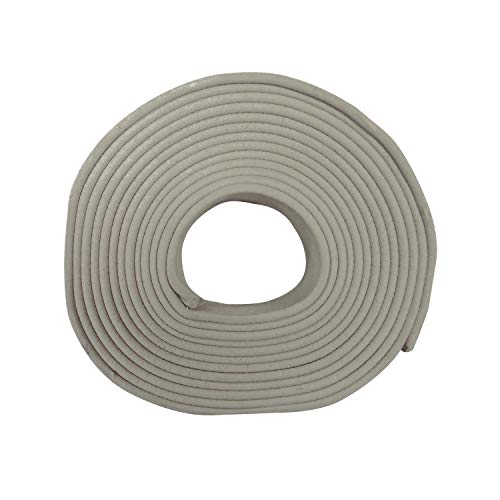 Frost King B2 Mortite Fingertip Caulking Cord, 1/8 in x 90 ftRope caulk: pliable putty you press into a gap in October and peel out in April, leaving no adhesive behind. | Seasonal window sealing | Published 1/8 in cord; fills gaps of roughly 1/16 in to 1/4 in when pressed | $6.67 · CHECK ON AMAZON |
| 3 |  M-D Building Products V-Flex Window Seal Weatherseal, 3/8 in x 17 ft, WhiteV-strip folds into the gap and springs back, so it seals a jamb that never closes to exactly the same place twice. | Door and window frame sides | Published 3/8 in wide x 17 ft; M-D publishes no gap range | $8.30 · CHECK ON AMAZON |
| 4 |  Frost King EPDM Rubber Self-Stick Weatherseal Tape, D-Section, 5/16 in x 1/4 in x 17 ftEPDM in a hollow D — the profile that keeps sealing at minus ten where foam tape has already gone hard. | Medium frame gaps | Published 1/4 in thick; compresses to seal gaps of roughly 1/8 in to 1/4 in | $7.69 · CHECK ON AMAZON |
#ad · how we are funded · price as of October 17, 2026
The default film kit
3M Indoor Window Insulator Kit, Five Pack
Published gap range
Five windows up to a published 3 ft x 5 ft each
#ad · how we are funded · price as of October 17, 2026
The kit most people mean when they say window film, with the Scotch mounting tape that is the actual reason it holds.
Where the number comes from3M publishes the window count and the per-window size the kit is designed for. Like every film kit it insulates the whole opening rather than sealing a measured gap.
- Windows covered
- 5
- Per window
- 3 ft x 5 ft
- Tape
- Scotch window film mounting tape
- Install
- Indoor
- Also reduces
- Condensation and frost buildup, per 3M
- Mounting
- Scotch double-sided window film tape, hair dryer shrink
What it does well
- The mounting tape is the best in the category and it is why the film stays up
- 3M publishes condensation and frost reduction, not just draft blocking
- Widely stocked, so a mid-winter top-up is easy
Where it fails
- Standard-weight film punctures easily
- Pre-sized sheets waste film on small windows
- Removing the tape from soft old paint takes patience
Who this is forFive ordinary windows and no cat.
Seasonal window sealing
Frost King B2 Mortite Fingertip Caulking Cord, 1/8 in x 90 ft
Published gap range
Published 1/8 in cord; fills gaps of roughly 1/16 in to 1/4 in when pressed
#ad · how we are funded · price as of October 17, 2026
Rope caulk: pliable putty you press into a gap in October and peel out in April, leaving no adhesive behind.
Where the number comes fromFrost King publishes the cord diameter (1/8") and length (90 ft). Rope caulk deforms into the gap, so one cord covers a range — press two strands together for a wider gap.
- Published diameter
- 1/8 in
- Published length
- 90 ft
- Removal
- Peels out, no residue when fresh
- Tools
- None — fingertip pressure
- Color
- Gray
- Mounting
- Pressed in by hand, no tools
What it does well
- Genuinely removable, which is why renters and old-window owners keep buying it
- No adhesive to fail and no surface prep beyond wiping dust off
- 90 ft does a lot of window
Where it fails
- Left in through summer heat it gets harder to remove cleanly
- Seals a window shut — no ventilation until you pull it
- Looks like what it is: putty in a gap
Who this is forOld double-hung windows you want sealed for winter and openable in spring.
Door and window frame sides
M-D Building Products V-Flex Window Seal Weatherseal, 3/8 in x 17 ft, White
Published gap range
Published 3/8 in wide x 17 ft; M-D publishes no gap range
#ad · how we are funded · price as of October 17, 2026
V-strip folds into the gap and springs back, so it seals a jamb that never closes to exactly the same place twice.
Where the number comes fromM-D publishes the strip width (3/8 in) and the roll length (17 ft), not a gap range. Our reasoning, stated as reasoning: a V-strip is folded along its crease and stands off roughly half its flat width, so a 3/8 in strip suits a hairline gap up to somewhere around 1/8 in. Past that it stops making contact and you want a bulb or D-section instead.
- Profile
- V (tension) strip
- Published width
- 3/8 in
- Published length
- 17 ft
- Mounting
- Self-adhesive
- Color
- White
- Mounting
- Self-adhesive, folded along the crease onto the jamb
What it does well
- Springs back after every close, so it keeps sealing as the door settles
- Nearly invisible once the door is shut
- A named manufacturer that publishes the width, which most V-strip listings do not
Where it fails
- 17 ft only just covers one standard door frame, so there is very little margin for a mis-cut
- Narrower than the 1/2 in strips, so it reaches a smaller gap
- Adhesive fails on rough, dusty or freshly painted wood
Who this is forThe sides and top of a door or a double-hung window, where the gap is thin and uneven.
Medium frame gaps
Frost King EPDM Rubber Self-Stick Weatherseal Tape, D-Section, 5/16 in x 1/4 in x 17 ft
Published gap range
Published 1/4 in thick; compresses to seal gaps of roughly 1/8 in to 1/4 in
#ad · how we are funded · price as of October 17, 2026
EPDM in a hollow D — the profile that keeps sealing at minus ten where foam tape has already gone hard.
Where the number comes fromFrost King publishes the section dimensions exactly: 5/16" wide by 1/4" thick, 17 ft long. A hollow D seals across roughly half to full its stated thickness, which is where the 1/8-1/4 in working figure comes from.
- Profile
- Hollow D
- Published width
- 5/16 in
- Published thickness
- 1/4 in
- Published length
- 17 ft
- Material
- EPDM rubber
- Mounting
- Self-adhesive onto the door stop
What it does well
- EPDM stays flexible in cold, which is the entire point of a winter seal
- Published dimensions to three fractions — you can actually match it to a measurement
- Compresses without taking a permanent set the way open-cell foam does
Where it fails
- 17 ft is one door frame; a house needs several rolls
- Adhesive still needs a clean, smooth surface
- Thicker than a V-strip, so it can stop a tight door from latching
Who this is forA door stop or window sash with a visible, consistent gap you have measured.
How we picked
- The order of work is chosen so free fixes are exhausted before anything is bought.
- Products are placed against published sections and the measured gap, never by shelf price.
We have not tested these products and we do not claim to have. The full method, including what we refuse to claim, is on how we pick.
What to leave alone
- Weep holes in a vinyl or aluminum frame. Those small slots drain rainwater out of the frame. Sealed, they hold water inside it.
- Trickle vents, if your windows have them. They exist to ventilate the room; blocking them moves the moisture problem to a wall you cannot see.
- Your egress window. Every bedroom needs one window that opens. Do not film it, do not rope-caulk it.
Once the windows are done, the same evening's work applies to the doors: best weather stripping for doors for the frames and best door sweeps for the gaps underneath.
Questions people actually ask
- How do I seal my windows for winter from the inside?
- Tighten the sash lock, find the leaks with incense smoke, seal the sash channels with V-strip and the sill with a D-section, caulk the frame-to-wall joint, and film the whole window last. Doing film first hides leaks you could have fixed permanently.
- What is the cheapest way to stop a drafty window?
- Tightening the sash lock, which is free, then rope caulk in the sash gaps, which is a few dollars for a 90-foot cord. Between them those two handle most old double-hung windows.
- Should I seal windows from the inside or the outside?
- Inside, for everything in this guide. Interior seals are protected from weather and UV, easier to fit and easier to remove. Exterior caulking around the frame is a separate maintenance job best done in dry weather above 50 F.
- Can I seal a window that has condensation on it?
- Not until you deal with the moisture. Tape will not bond to a damp frame, and sealing over a condensing window traps the water where you cannot see it. Condensation on the inside means indoor humidity is high — ventilate and warm the surface before sealing.
- When should I seal my windows?
- Early fall, while it is still warm enough for adhesives to bond — most pressure-sensitive tapes need above about 50 F. Waiting for the first cold snap is why so many seals fail in their first month.
Sources
- Frost King — published shrink film window kit frame compatibility and fixings
- 3M — published five-window indoor insulator kit contents and use
Every specification on this page traces to a published manufacturer or retailer listing. Where a maker publishes no working gap range, we say so rather than estimating one.
Read next
The best window insulation kits, by published coverage
Shrink-film kits ranked by published coverage and film weight, plus the frame checks that decide whether the tape holds.
The best weather stripping tape for windows
Tape, V-strip and rope caulk placed by gap and by where on the window they can survive.
How to find drafts in your house
Five tests, no equipment, an hour — ordered so you find the big leaks before the small ones.
The best window air conditioner covers for winter
An indoor cover blocks the air path; an outdoor one protects the machine. And the accordion side panels leak more than either addresses.
The best weather stripping for casement windows, matched to the groove you actually have
Casements compress shut, so they take a bulb gasket. Match the bulb size and the groove type.
The best rope caulk and caulking cord, and how much of it you actually need
No tools, no cure, nothing to fail. Seals a window for one winter and peels out in spring.