02 / WINDOWS
The best rope caulk and caulking cord, and how much of it you actually need
It is the least impressive product on this site and the one we end up recommending most often. No tools, no cure time, nothing to fail in the cold, and it comes back out in one piece.
We earn a commission on some links here, at no extra cost to you. It does not change what we recommend or the order they appear in. How we are funded
Buy 1/8 in caulking cord in the color closest to your frame, and about 90 ft for a house or 45 ft for a window or two. It presses into the gap by hand, needs no tools and no cure time, seals the window shut for the season, and peels out in one piece in spring if you take it out before summer.
Why this unglamorous stuff keeps winning
Rope caulk goes by several names. Caulking cord, caulk cord, mortite, putty rope: all the same thing, a soft non-hardening putty extruded into a long rope and wound on a roll. You tear off a length, press it into a gap with your thumb, and that is the entire method.
It shows up as a recommended extra on more pages of this site than any other product, and the reason is that it has almost no failure modes. Adhesive weatherstrip fails when the bond lets go, usually at a corner, usually in January. Foam fails when it takes a permanent set. Shrink film fails when the tape lifts. Rope caulk has no adhesive bond, no cure, no elasticity to lose and no tape.
What it has instead is one hard limitation, and it is total: the window it seals cannot be opened until you take the cord out. Everything else on this page follows from that one fact.
Where the cord actually goes on a window
The cord is not laid along the outside of the frame like a decorative bead. It is pressed INTO the joint, so the putty fills the gap and the two surfaces close on it. On an old double-hung window there are four places worth doing, and they are not equally important.
- The meeting rail, where the upper and lower sashes overlap in the middle. On most old double-hungs this is the single biggest leak, and it is the first place to put cord.
- The bottom of the lower sash, where it meets the sill. Second biggest on most windows, and easy to reach.
- The vertical joints between the sash sides and the frame. Do these after the first two, because they are usually narrower.
- Around the glass itself, where old glazing putty has shrunk away from the pane. Genuinely worth checking on a window over about fifty years old, and often overlooked entirely.
Press with a thumb and work along in short sections rather than trying to lay a whole run at once. Where the gap is wider than the cord, use a doubled length rather than stretching one thin: stretched cord thins in the middle and that is where it pulls away first.
Match the part to your gap
Measure at the widest point. Then read across. If your measurement sits on a boundary, take the larger band — a seal that is slightly too big compresses, and one that is too small does nothing at all.
| Your gap | Part type | Our pick | Price |
|---|---|---|---|
| A whole house, gray is fine | 1/8 in cord, 90 ft | 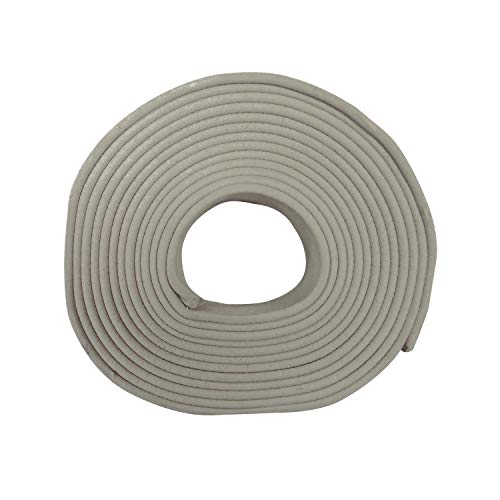 Frost King B2 Mortite Fingertip Caulking Cord, 1/8 in x 90 ftThe default. Mortite is the name most people are actually searching for. | $6.67 · CHECK ON AMAZON |
| A whole house, cheapest per foot | 1/8 in cord, 90 ft |  M-D Building Products Replaceable Caulk Cord Weatherseal, Gray, 1/8 in x 90 ftThe other big weatherstrip brand, same job, lowest price per foot here. | $6.48 · CHECK ON AMAZON |
| Stained or dark wood frames | Woodtone cord, 90 ft |  Frost King B2WT Mortite Caulking Cord, Woodtone, 19 oz / 90 ftDisappears on varnished wood, where gray reads as a repair. | $10.77 · CHECK ON AMAZON |
| White vinyl or painted frames | White cord, 90 ft x 2 |  M-D Building Products Caulking Cord, White, 90 ft, 2-PackThe only white in stock. Sold as a two-pack, so read the skip list first. | $25.91 · CHECK ON AMAZON |
| One or two windows only | 1/8 in cord, 45 ft |  Frost King F4 Mortite Caulking Cord, 45 ft, 9-1/2 oz, GrayHalf the length for about the same money, and still the right buy for a small job. | $6.79 · CHECK ON AMAZON |
Color matters more than you expect
This is the thing people underestimate, and it is why three of the five picks here differ mainly by color. Rope caulk cannot be painted successfully. It never hardens, so paint over it stays soft, marks, and peels off in sheets when you eventually remove the cord. Whatever color you buy is the color you look at all winter.
Gray is the default and the cheapest, and on an old painted-white sash it reads as a gray line around every joint. Some people genuinely do not care; plenty of people care a great deal by February. Woodtone disappears on varnished or stained frames and looks wrong on white. White disappears on modern vinyl and painted frames, and it is the hardest color to find.
Be honest with yourself about which of those you are before buying the cheapest roll. This is a product that lives in the visible part of a room for several months.
The one-winter question
Rope caulk is a seasonal product used by people who want a seasonal fix, and the two groups it suits best are renters and anyone with original windows they do not want to damage.
For renters it is close to ideal: nothing is screwed, nailed or stuck down, there is no adhesive residue, and a frame that has had cord in it for a winter looks the same afterwards as it did before. That is a stronger claim than adhesive weatherstrip can make, and the wider set of reversible options is collected in renter-friendly draft fixes.
For an old house it matters for a different reason. Original sashes and their paint are the thing you are trying not to wreck, and the usual alternatives all attach to them. Cord does not. The trade is that you are committing to take it out each spring, and the people who have a bad experience with this product are almost always the ones who did not.
What we would skip, and why
Nobody in this category ever declines to recommend something. That is what makes universal praise worth ignoring. Here is what we would not buy.
Rope caulk on a window you need to open
This is the first thing to get straight, because it is the difference between a good winter and a ruined sash. Pressing cord into the joint between a sash and its frame seals that window SHUT. That is fine for a spare room, a north-facing window nobody opens, or a basement. It is not fine for a bedroom that needs airing, a kitchen, or a fire escape route. For a window that still has to open, the parts are in best window weather stripping tape, and the three-way decision is worked through in rope caulk vs V-seal vs film.
Leaving it in through the summer
Rope caulk comes out cleanly in spring and that is most of its appeal. Left in through a hot summer it gets harder, grips the paint more stubbornly, and starts taking finish with it when you finally pull. The habit that makes this product work is taking it out when the heating goes off, not leaving it and dealing with it next October. If you know you will never get round to that, a permanent seal is the more honest purchase.
Using it as a substitute for real caulk outdoors
Cord is non-hardening by design. It never skins over, it stays slightly tacky, and it is not a weatherproof exterior sealant. On an outside joint it collects grit, sags in the heat and does not survive rain running over it. Anywhere you want a permanent, paintable, water-shedding seal, you want gun-grade caulk and possibly backer rod behind it, which is covered in spray foam vs caulk vs backer rod.
Paying two and a half times for the same material
There is a 90 ft gray cord on the market from a third brand at roughly two and a half times what the two picks above cost, with nothing published that distinguishes it: same length, same gray, same non-hardening putty. We did not rank it, and we are naming the reason rather than quietly leaving it out. If the cheaper two are out of stock it will do the job; at full price it is simply a more expensive version of the same thing.
Expecting it to stick to a dirty or damp frame
Rope caulk does not cure and it does not bond chemically. It holds by being pressed into contact, which means it holds badly on dust, flaking paint, condensation or a frame that is still damp from washing. Nearly every complaint that it 'fell out' is a surface problem. Wipe the frame, let it dry, and press the cord in properly with a thumb rather than laying it on.
What to use instead, and when
The honest position is that rope caulk is one of three ways to deal with a drafty window and it is not always the right one. The deciding question is not price, it is whether the window has to open.
| Rope caulk | Weatherstrip tape | Shrink film | |
|---|---|---|---|
| Window can still open | No | Yes | No |
| Tools needed | None | Scissors | Hairdryer |
| Comes off cleanly in spring | Yes, if removed before summer | Often not | Tape residue is common |
| Insulates the glass itself | No | No | Yes |
| Visible when fitted | A colored line at each joint | Slight | Slight, if fitted taut |
| Best for | Windows staying shut, old frames, renters | Windows in daily use | Biggest effect per dollar |
If the window is staying shut anyway and you want the biggest temperature difference for the money, film beats cord, because film insulates the whole pane rather than only closing the joints. That case is made properly in does window film actually work, and the kits are in best window insulation kits. Plenty of people use both: cord in the joints, film over the opening.
And if the draft turns out not to be the window at all but the gap between the frame and the wall behind the trim, no amount of cord in the sash will help. How to find drafts in your house covers telling those apart in about ten minutes, and it is worth doing before you buy anything.
Taking it out without taking the paint with it
Removal is the step that decides whether you use this product again. Done in spring it is genuinely a one-piece pull: get a fingernail or a plastic scraper under one end and the whole run lifts away. Done in September after a hot summer it is a different job.
- 1Take it out when the heating goes off, not when you next notice it.
- 2Start at a corner and pull along the run at a shallow angle rather than straight out from the frame.
- 3If a piece breaks and leaves a smear, work it off with a ball of the cord itself, which picks up its own residue better than a cloth does.
- 4Anything still stubborn comes off with an adhesive remover and a plastic scraper rather than a blade, which is why one is in the kit below.
Complete the kit
The parts that decide whether the seal you just bought actually holds. Skip these and you will be doing the job again in March.

Removing old weatherstrip adhesive
Goo Gone Pro-Power Adhesive Remover Spray, 16 fl oz, with Scraper
The step everybody skips: the new tape will not stick to the residue the old tape left behind.

Door and window frame sides
M-D Building Products V-Flex Window Seal Weatherseal, 3/8 in x 17 ft, White
V-strip folds into the gap and springs back, so it seals a jamb that never closes to exactly the same place twice.

Deep gaps before caulking
Frost King C21CP-C Caulk Saver Backer Rod, 3/8 in x 350 ft
Backer rod: the foam you push into a deep gap so the caulk over it is a seal rather than a bottomless hole.
#ad · how we are funded · price as of October 17, 2026
How we picked
- We rank on published length and diameter first, because those are close to the only specifications this category publishes, and length against the size of your job is the decision most people actually get wrong.
- Color second, treated as a fitting decision rather than a ranking. Gray, woodtone and white exist because a visible putty line on the wrong frame is the commonest regret with this product.
- Price per foot third, and we say plainly where a pick is poor value per foot but still the right buy, which is the case for the short roll.
- No maker publishes a working gap range, and that is defensible here rather than a gap in the data: the cord has no fixed section once it is pressed into a joint. We did not test these. Prices come from the live price layer and are dated; the full method is published.
We have not tested these products and we do not claim to have. The full method, including what we refuse to claim, is on how we pick.
Questions people actually ask
- What is rope caulk actually made of?
- A soft, non-hardening putty extruded into a rope and wound on a roll. The important word is non-hardening: it never cures or skins over, which is exactly why it can be pulled back out in one piece months later. It is sold under several names, including caulking cord, caulk cord and mortite, and they all describe the same material.
- How much rope caulk do I need for one window?
- Measure around the sash rather than guessing. A typical double-hung sealed at the meeting rail, both sides and the bottom uses more than people expect, and a 45 ft roll covers roughly two average windows. For a whole house a 90 ft roll is the sensible unit, and it usually costs about the same as the 45 ft one.
- Can you paint over rope caulk?
- Not successfully. It never hardens, so paint on top of it stays soft, marks easily and comes away in sheets when you remove the cord. Choose the color you can live with instead: gray is the default and the cheapest, woodtone suits stained or varnished frames, and white suits modern vinyl and painted ones.
- Does rope caulk seal the window shut?
- Yes, and that is the main thing to understand before buying. The cord is pressed into the joint between the sash and the frame, so the window cannot be opened until it comes out. Use it on windows that will stay shut all winter, and use weatherstrip tape or a V-strip on anything that still needs to open.
- When should I take rope caulk out?
- When the heating goes off, not later. Removed in spring it usually lifts away in one piece with a fingernail. Left through a hot summer it stiffens, grips the paint harder and is much more likely to take finish with it, which is the single biggest cause of people deciding they dislike the product.
- Is rope caulk better than weather stripping?
- For a window staying shut all winter, on an old frame, or in a rental, it is usually the better choice: nothing is stuck down and nothing is left behind. For a window in daily use it is the wrong product entirely, because it seals the window closed. Neither is better in general; they answer different questions.
Read next
Rope caulk, V-seal or film: three ways to seal a window
Three ways to seal a window, decided by one question: does it still have to open?
The best weather stripping tape for windows
Tape, V-strip and rope caulk placed by gap and by where on the window they can survive.
How to seal windows for winter from the inside
The order of work that stops you filming over a leak you could have closed for free.
Draft fixes for renters that leave no trace
Rope caulk, stoppers and removable film — the fixes that come out clean at move-out.
The best window insulation kits, by published coverage
Shrink-film kits ranked by published coverage and film weight, plus the frame checks that decide whether the tape holds.