02 / WINDOWS
The best weather stripping for casement windows, matched to the groove you actually have
Two numbers decide this and almost no one checks the second one. Bulb size sets how well it seals; groove type decides whether the gasket stays in the window at all.
We earn a commission on some links here, at no extra cost to you. It does not change what we recommend or the order they appear in. How we are funded

A casement compresses shut, so it takes a bulb gasket rather than the pile or V-seal a sliding sash uses. Pull an inch of old gasket out and check two things: the bulb diameter, usually 1/4 in or 5/16 in, and whether the groove is a plain kerf or a T-slot. Those two answers pick the part.
Why most window weatherstrip advice does not apply here
Windows come in two mechanical families and they want opposite things from a seal. A double-hung or a horizontal slider moves its sash PAST the frame, so the seal has to tolerate something rubbing along it: that is what pile, brush and thin V-seal are for. A casement swings in on hinges and is cranked shut, so the sash arrives perpendicular and presses onto the frame.
That is a compression joint, and compression joints want a bulb: a hollow tube of flexible material that squashes and pushes back. Put pile in a compression joint and it flattens permanently within a season. Put a bulb in a sliding joint and the sash tears it. Neither part is bad; they are for different windows, and the listings rarely make the distinction because both say window weather stripping on the front.
So the first useful thing to establish is what you have. If it has a crank handle, or it swings out from one side, or it is an awning window hinged at the top, everything on this page applies. If the sash slides up or sideways, the right page is best window weather stripping tape.
Bulb size: what actually goes wrong
The bulb has to be big enough that the closed sash squashes it, and small enough that the window still latches. Those two requirements pull in opposite directions, and the common sizes exist because they are the two useful points between them.
If your window still closes and latches easily and you can feel a draft, the original gasket has probably gone flat rather than gone missing, and a fresh 1/4 in bulb restores what was there. If the window has to be pulled to before the handle will go over, or the sash has visibly dropped so the gap is wider at one corner, the 5/16 in bulb is the one that takes up the difference.
The mistake to avoid is treating the bigger bulb as strictly better. A casement latch works through a crank operator with a fixed travel, and forcing it closed onto an oversized gasket loads that mechanism every time the window is shut. Replacing a gasket costs very little. Replacing an operator does not.
Match the part to your gap
Measure at the widest point. Then read across. If your measurement sits on a boundary, take the larger band — a seal that is slightly too big compresses, and one that is too small does nothing at all.
| Your gap | Part type | Our pick | Price |
|---|---|---|---|
| Kerf groove, sash no longer bears evenly | Bulb gasket, 5/16 in |  Seal Supply Bulb Kerf Mount Window Gasket, 5/16 in, 17 ft, WhiteThe bigger of the two common bulbs. Takes up slack in a window that has dropped. | $18.00 · CHECK ON AMAZON |
| Kerf groove, window still closes easily | Bulb gasket, 1/4 in |  showingo Bulb Bubble Kerf Mount Window Gasket, 1/4 in, 17 ft, TanThe smaller bulb, so the sash still latches. Try this first on a tight window. | $13.99 · CHECK ON AMAZON |
| Tall sash, or a dark frame | Bulb gasket, 5/16 in, 25 ft |  Seal Supply Bulb Kerf Mount Window Gasket, 5/16 in, 25 ft, BlackEnough for one continuous run around a big sash, and black suits a bronze frame. | $24.00 · CHECK ON AMAZON |
| Groove has a chamber behind the slot | T-slot bulb gasket, 3/16 in slot |  Seal Supply T-Slot Mount Window Gasket, 5/16 in Bulb for 3/16 in Slot, 17 ft, WhiteA T-slot will not hold kerf gasket. This is the version with the right foot. | $18.00 · CHECK ON AMAZON |
| No groove at all, or renting | Adhesive V-seal, 3/8 in |  M-D Building Products V-Flex Window Seal Weatherseal, 3/8 in x 17 ft, WhiteOn the frame, not the compression face. M-D publishes the 3/8 in width, not a gap range. | $8.62 · CHECK ON AMAZON |
Kerf or T-slot, and why it is not a detail
This is the spec people skip, and it is the one that decides whether the part can be fitted at all. Both grooves look like a thin dark line in the frame when the gasket is in them. The difference is in the cross-section.
- A kerf is a plain slit, the same width all the way in. The gasket has a thin spine with small barbs down it, and the barbs bite the sides of the slit to hold it.
- A T-slot has a narrow opening with a wider chamber behind it. The gasket has a T-shaped foot that is fed in from one end and cannot pull straight out.
- They do not substitute. A barbed spine in a T-slot has nothing to grip, so the gasket works loose over a winter. A T foot will not go into a kerf at all.
One further number matters if you have a T-slot: the slot width. The T-slot pick here publishes 3/16 in, which is a common size and not a universal one. Measure the opening of your slot with the gasket out, and if it is clearly wider than that, you need a different part rather than a hopeful fit.
When the gasket is not the problem
This section will talk some readers out of a purchase, which is the point. A casement seals by being pulled tight against the frame by its hardware. If the hardware is not doing that evenly, no gasket in any size will fix it, and fitting a fatter one just hides the symptom while wearing out the mechanism.
The diagnostic is a strip of paper. Close and latch the window on a strip of ordinary paper, then pull. If it drags out under real resistance, the sash is bearing there. Do it at the top, the middle, the bottom and both corners. Even resistance all round means your seal is the variable, and a new gasket will help. Resistance at the latch and nothing at the hinge corner means the sash is not being pulled in squarely, and that is a hinge, operator or adjustment problem.
Two other things worth ruling out before spending money. A casement with a rotten or swollen sash bottom will never close evenly again, whatever is in the groove. And the air you feel at a window is often not coming through the window at all but around the frame, through the gap between the frame and the wall behind the trim. How to find drafts in your house covers telling those apart, and it is worth ten minutes before ordering anything.
Fitting it without leaving a gap at the corners
Gasket goes in as one continuous run wherever you can manage it, because every joint is a place air can get through and a place the new gasket can start working its way out. That is the practical reason one of the picks here is a 25 ft roll rather than 17 ft: a tall casement plus the corners adds up faster than people expect.
- 1Pull the old gasket out completely and clean the groove. Old gaskets leave crumbs and the new spine will not seat on top of them.
- 2Start at a bottom corner rather than a top one, so the join ends up where water is not running past it.
- 3Push the spine in with a thumb, working along a few inches at a time. Do not stretch it as you go: stretched gasket shrinks back over the following weeks and leaves you short at the far end.
- 4At each corner, keep it continuous and turn it rather than cutting. A mitered corner in a bulb gasket is a hole.
- 5Cut the end slightly long and compress it to meet the start, so the join is under pressure rather than butted loose.
What we would skip, and why
Nobody in this category ever declines to recommend something. That is what makes universal praise worth ignoring. Here is what we would not buy.
Buying pile or brush weatherstrip because it said it was for windows
Pile and brush strip is for a sash that SLIDES: a double-hung, a horizontal slider, a patio door. It works by brushing against a surface moving past it. A casement does not slide, it swings in and compresses against the frame, and a pile strip in a compression joint gets squashed and stays squashed. Almost all the window weatherstrip sold on the high street assumes a sliding sash, which is why so much of it disappoints on a casement.
Going up a bulb size because bigger must be tighter
It is the obvious move and it is usually wrong. A casement pulls shut on a multi-point latch through a crank operator, and that mechanism has a fixed amount of travel. Fit a bulb bigger than the gap it has to fill and the window either will not latch or latches under a load it was not designed for, which puts wear straight into the operator. Fit the size that matches the groove and the gap, and if it still leaks, the problem is the hardware, not the gasket.
Ordering before you have looked at the groove end-on
This is the failure that wastes the most money in this category, because the part looks right until you try to fit it. A KERF is a plain narrow slit that grips a barbed spine. A T-SLOT has a wider chamber behind the opening that holds a T-shaped foot. Kerf gasket in a T-slot rattles loose; T-slot gasket will not push into a kerf. Pull an inch of the old gasket out and look at the end of it before you order anything.
Judging casement gaskets on noise claims
Listings in this category promise soundproofing without naming a test, a frequency or a window, and we publish no figure from any of them. What is verifiable before you buy is the bulb diameter, the mounting type, the slot dimension where the maker gives one, the published length and the color. Those are the specs the picks here are ranked on, because they are the ones that decide whether the part fits.
If your casement has no groove
Older wooden casements and some replacement units were never grooved. There is nothing to push a gasket into, and the honest answer is that you are in a different product category: an adhesive strip fitted to the frame rather than a gasket fitted into it.
The adhesive V-seal here is the pick for that, and the important part is where it goes. It belongs on the frame face alongside the stop, where the sash edge meets it, rather than on the surface the sash compresses against. Put adhesive strip on the compression face of a casement and you will have the same latching problem as an oversized bulb, with the added failure mode of a bond that has to survive the sash pressing on it.
If you are renting, or you want something entirely reversible for one winter, rope caulk is worth knowing about: it presses into the gap, seals for a season and peels out in spring without residue. The comparison is in rope caulk vs V-seal vs film, and the renter-specific options are collected in renter-friendly draft fixes.
Complete the kit
The parts that decide whether the seal you just bought actually holds. Skip these and you will be doing the job again in March.

Removing old weatherstrip adhesive
Goo Gone Pro-Power Adhesive Remover Spray, 16 fl oz, with Scraper
The step everybody skips: the new tape will not stick to the residue the old tape left behind.
Seasonal window sealing
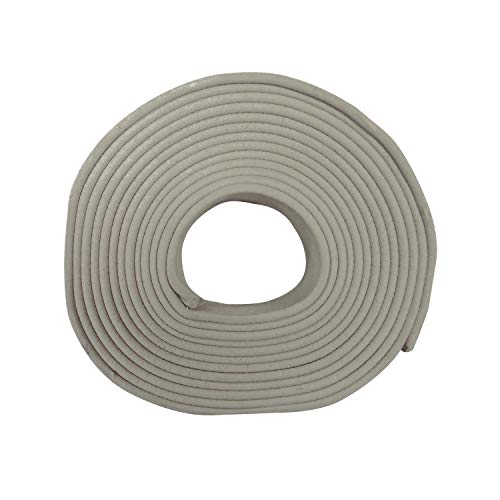
Frost King B2 Mortite Fingertip Caulking Cord, 1/8 in x 90 ft
Rope caulk: pliable putty you press into a gap in October and peel out in April, leaving no adhesive behind.

Deep gaps before caulking
Frost King C21CP-C Caulk Saver Backer Rod, 3/8 in x 350 ft
Backer rod: the foam you push into a deep gap so the caulk over it is a seal rather than a bottomless hole.
#ad · how we are funded · price as of October 16, 2026
How we picked
- We rank on mounting type first, because a gasket that will not stay in the groove seals nothing. Kerf and T-slot are different parts, and every pick states which it is.
- Published bulb diameter second. This is the sealing spec, and the two common sizes, 1/4 in and 5/16 in, are placed against how the window currently closes rather than ranked against each other.
- Published slot dimension where the maker gives one third, and we say so when they do not. One pick here publishes both bulb and slot, which is rare enough in this category to be worth rewarding.
- No maker here publishes a working gap range, because these are specified by bulb size rather than gap, and every entry says that plainly. We did not test these. Prices come from the live price layer and are dated; the full method is published.
We have not tested these products and we do not claim to have. The full method, including what we refuse to claim, is on how we pick.
Questions people actually ask
- What kind of weather stripping do casement windows use?
- A bulb gasket that sits in a groove in the frame or the sash edge. Casements compress shut rather than sliding, so the seal has to squash and push back, which is what a hollow bulb does. Pile, brush and most adhesive tape are made for sliding sashes and flatten permanently in a compression joint.
- How do I know what size gasket my casement takes?
- Pull an inch of the existing gasket out and look at the cut end. The bulb will measure about 1/4 in or about 5/16 in, and those are the two common sizes. If there is no old gasket to copy, start with the smaller one on a window that still latches easily, and the larger one on a window whose sash has dropped or that no longer bears evenly.
- What is the difference between kerf mount and T-slot mount?
- The shape of the groove and the foot that fits it. A kerf is a plain slit and the gasket has a thin barbed spine that grips its sides. A T-slot has a wider chamber behind the opening and the gasket has a T-shaped foot fed in from one end. They are not interchangeable in either direction, so check the groove before ordering.
- My casement still leaks after a new gasket. What now?
- Check whether the sash is bearing evenly. Close it on a strip of paper and pull; do that at the top, bottom, middle and both corners. Even drag all round means the seal is the variable. Drag at the latch and none at the hinge corner means the hardware is not pulling the sash in squarely, and a bigger gasket will only load the operator rather than fix it.
- Can I use adhesive weather stripping on a casement window?
- Only if there is no groove, and then it goes on the frame face alongside the stop rather than on the surface the sash compresses against. Adhesive strip in the compression path causes the same latching problem as an oversized bulb, and it has a bond that has to survive being pressed on every time the window shuts.
- How much gasket do I need for one casement window?
- Measure around the full perimeter of the opening and add for the corners, which take more than the straight measurement suggests. A standard casement is comfortably inside a 17 ft roll, but a tall one is not, and running out two feet short means a joint in the middle of a run. If in doubt, the 25 ft roll avoids the problem.
Read next
The best weather stripping tape for windows
Tape, V-strip and rope caulk placed by gap and by where on the window they can survive.
Rope caulk, V-seal or film: three ways to seal a window
Three ways to seal a window, decided by one question: does it still have to open?
How to seal windows for winter from the inside
The order of work that stops you filming over a leak you could have closed for free.
Draft fixes for renters that leave no trace
Rope caulk, stoppers and removable film — the fixes that come out clean at move-out.
How to find drafts in your house
Five tests, no equipment, an hour — ordered so you find the big leaks before the small ones.