01 / DOORS
The best weather stripping for doors, by published thickness
The sides and top of the door leak more than the bottom on most houses. This is the part that fixes it, and the thickness is the whole decision.
We earn a commission on some links here, at no extra cost to you. It does not change what we recommend or the order they appear in. How we are funded

For most doors, a hollow EPDM D-section published at 1/4 inch thick is the right weather stripping: it seals a gap of roughly an eighth to a quarter inch and stays flexible when it is cold. Use a V-strip for a hairline gap, silicone if your winters are hard, and thick open-cell foam only for a warped frame indoors.
People buy weather stripping by brand and by color. The thing that actually decides whether it works is the number printed on the pack: the section thickness. Everything below is placed by that number, against a gap you can measure with a folded index card.
Measure the frame gap in ninety seconds
- 1Close the door and run a dollar bill or a strip of paper into the gap between the door and the stop, at the latch side.
- 2Close the door on it and pull. If it slides out with no resistance, that section is not sealing at all.
- 3Repeat at the top corner, the middle of the latch side and the hinge side. Note where it pulls free.
- 4For the actual measurement, fold an index card until it just fills the gap and measure the folded thickness. A card is about 0.01 inch, so ten folds is a tenth of an inch.
- 5Buy a seal whose published thickness is a little larger than that measurement, never smaller.
Match the part to your gap
Measure at the widest point. Then read across. If your measurement sits on a boundary, take the larger band — a seal that is slightly too big compresses, and one that is too small does nothing at all.
| Your gap | Part type | Our pick | Price |
|---|---|---|---|
| Hairline to 1/16 in | V-strip (tension seal) |  M-D Building Products V-Flex Window Seal Weatherseal, 3/8 in x 17 ft, WhiteSprings back after every close, so it keeps working as the door settles on its hinges. | $8.30 · CHECK ON AMAZON |
| 1/8 in to 1/4 in | Hollow D-section rubber |  Frost King EPDM Rubber Self-Stick Weatherseal Tape, D-Section, 5/16 in x 1/4 in x 17 ftPublished 1/4 in thick. EPDM stays flexible below freezing, which foam does not. | $7.69 · CHECK ON AMAZON |
| 3/16 in to 5/16 in, hard climate | Silicone bulb |  Protalwell Silicone D-Section Door Seal, 3/8 in W x 5/16 in T, 20 ftCosts more and does not stiffen in a hard freeze or chalk in summer sun. | $11.99 · CHECK ON AMAZON |
| 1/4 in to 3/8 in | Thick open-cell foam |  fowong Open Cell Foam Weather Stripping, 1 in x 1/2 in x 13 ftHalf an inch of squash for a warped frame. Not a long-life exterior seal. | $16.99 · CHECK ON AMAZON |
Material matters more than profile in the cold
Profile decides which gaps a seal can span. Material decides whether it still seals in February. EPDM and silicone stay elastic through a hard freeze; vinyl stiffens; open-cell foam takes on water and then freezes solid. If you are reading this in a place with real winters, that is the whole argument, and there is a longer version in foam versus V-seal versus silicone.
| Material | Cold behavior | Water | Typical life |
|---|---|---|---|
| EPDM rubber | Stays flexible; the standard for exterior seals | Sheds it | Several seasons |
| Silicone | Best of the group in a hard freeze | Sheds it | Longest here |
| Vinyl | Stiffens, seals worse | Sheds it | A few seasons |
| Open-cell foam | Compresses permanently | Absorbs it unless faced | One season outdoors |
Quick picks
Ranked for fit, not for hype. Tap a row to jump to the full write-up, or go straight to the listing.
| # | Product | Best for | Gap range | Price |
|---|---|---|---|---|
| 1 | Frost King EPDM Rubber Self-Stick Weatherseal Tape, D-Section, 5/16 in x 1/4 in x 17 ftEPDM in a hollow D — the profile that keeps sealing at minus ten where foam tape has already gone hard. | Medium frame gaps | Published 1/4 in thick; compresses to seal gaps of roughly 1/8 in to 1/4 in | $7.69 · CHECK ON AMAZON |
| 2 | M-D Building Products V-Flex Window Seal Weatherseal, 3/8 in x 17 ft, WhiteV-strip folds into the gap and springs back, so it seals a jamb that never closes to exactly the same place twice. | Door and window frame sides | Published 3/8 in wide x 17 ft; M-D publishes no gap range | $8.30 · CHECK ON AMAZON |
| 3 | Protalwell Silicone D-Section Door Seal, 3/8 in W x 5/16 in T, 20 ftSilicone rather than EPDM or foam: it costs more per foot and it is the one profile that does not stiffen when the temperature drops. | Cold climates | Published 5/16 in thick; suits a measured gap of roughly 3/16 in to 5/16 in | $11.99 · CHECK ON AMAZON |
| 4 |  Frost King EPDM Rubber Foam Weather Stripping Tape, 17 ft x 1/4 inSponge-rubber tape: the thing most people buy first, and the right answer on a smooth frame with a small, even gap. | The simplest honest fix | Published 1/4 in thick; seals gaps up to about 1/8 in once compressed | $10.16 · CHECK ON AMAZON |
| 5 | fowong Open Cell Foam Weather Stripping, 1 in x 1/2 in x 13 ftHalf-inch-thick open-cell foam for the gap nothing else reaches — an AC surround, a loose sash, a warped frame. | Large, irregular gaps | Published 1/2 in thick; fills gaps of roughly 1/8 in to 3/8 in | $16.99 · CHECK ON AMAZON |
| 6 |  Frost King P D-Section Rubber Self-Stick Weatherseal, GrayThe same D-section in gray, which matters more than it sounds on an aluminum window where brown reads as a mistake. | Gray and aluminum frames | Published 1/4 in thick; seals gaps of roughly 1/8 in to 1/4 in | $9.93 · CHECK ON AMAZON |
#ad · how we are funded · price as of October 17, 2026
Medium frame gaps
Frost King EPDM Rubber Self-Stick Weatherseal Tape, D-Section, 5/16 in x 1/4 in x 17 ft
Published gap range
Published 1/4 in thick; compresses to seal gaps of roughly 1/8 in to 1/4 in
#ad · how we are funded · price as of October 17, 2026
EPDM in a hollow D — the profile that keeps sealing at minus ten where foam tape has already gone hard.
Where the number comes fromFrost King publishes the section dimensions exactly: 5/16" wide by 1/4" thick, 17 ft long. A hollow D seals across roughly half to full its stated thickness, which is where the 1/8-1/4 in working figure comes from.
- Profile
- Hollow D
- Published width
- 5/16 in
- Published thickness
- 1/4 in
- Published length
- 17 ft
- Material
- EPDM rubber
- Mounting
- Self-adhesive onto the door stop
What it does well
- EPDM stays flexible in cold, which is the entire point of a winter seal
- Published dimensions to three fractions — you can actually match it to a measurement
- Compresses without taking a permanent set the way open-cell foam does
Where it fails
- 17 ft is one door frame; a house needs several rolls
- Adhesive still needs a clean, smooth surface
- Thicker than a V-strip, so it can stop a tight door from latching
Who this is forA door stop or window sash with a visible, consistent gap you have measured.
Door and window frame sides
M-D Building Products V-Flex Window Seal Weatherseal, 3/8 in x 17 ft, White
Published gap range
Published 3/8 in wide x 17 ft; M-D publishes no gap range
#ad · how we are funded · price as of October 17, 2026
V-strip folds into the gap and springs back, so it seals a jamb that never closes to exactly the same place twice.
Where the number comes fromM-D publishes the strip width (3/8 in) and the roll length (17 ft), not a gap range. Our reasoning, stated as reasoning: a V-strip is folded along its crease and stands off roughly half its flat width, so a 3/8 in strip suits a hairline gap up to somewhere around 1/8 in. Past that it stops making contact and you want a bulb or D-section instead.
- Profile
- V (tension) strip
- Published width
- 3/8 in
- Published length
- 17 ft
- Mounting
- Self-adhesive
- Color
- White
- Mounting
- Self-adhesive, folded along the crease onto the jamb
What it does well
- Springs back after every close, so it keeps sealing as the door settles
- Nearly invisible once the door is shut
- A named manufacturer that publishes the width, which most V-strip listings do not
Where it fails
- 17 ft only just covers one standard door frame, so there is very little margin for a mis-cut
- Narrower than the 1/2 in strips, so it reaches a smaller gap
- Adhesive fails on rough, dusty or freshly painted wood
Who this is forThe sides and top of a door or a double-hung window, where the gap is thin and uneven.
Cold climates
Protalwell Silicone D-Section Door Seal, 3/8 in W x 5/16 in T, 20 ft
Published gap range
Published 5/16 in thick; suits a measured gap of roughly 3/16 in to 5/16 in
#ad · how we are funded · price as of October 17, 2026
Silicone rather than EPDM or foam: it costs more per foot and it is the one profile that does not stiffen when the temperature drops.
Where the number comes fromThe listing publishes a 3/8 in width and a 5/16 in thickness across a 20 ft roll. Thickness is the figure that matters: our general rule, published at /how-we-pick, is that a compressible seal works from about half its thickness up to its full thickness, which puts this one at roughly 3/16 to 5/16 in.
- Material
- Silicone
- Published width
- 3/8 in
- Published thickness
- 5/16 in
- Published length
- 20 ft
- Profile
- D-section
- Mounting
- Self-adhesive
What it does well
- Silicone keeps its flexibility through a hard freeze, which is the whole reason to pay more than foam
- Publishes both the material and the section, which most listings in this category do not
- Does not chalk or crack in sunlight the way vinyl does
Where it fails
- More expensive per foot than foam or EPDM
- Adhesive on silicone is fussier than on rubber — surface prep matters more
- Black only in this section, which shows on a white frame
Who this is forA door or hatch in a house that gets a real winter.
The simplest honest fix
Frost King EPDM Rubber Foam Weather Stripping Tape, 17 ft x 1/4 in
Published gap range
Published 1/4 in thick; seals gaps up to about 1/8 in once compressed
#ad · how we are funded · price as of October 17, 2026
Sponge-rubber tape: the thing most people buy first, and the right answer on a smooth frame with a small, even gap.
Where the number comes fromFrost King publishes 17 ft x 1/4 in. Sponge tape seals by being squashed, so the usable gap is well under the stated thickness — count on about half.
- Material
- EPDM sponge rubber
- Published thickness
- 1/4 in
- Published length
- 17 ft
- Mounting
- Self-adhesive
- Color
- Brown
- Mounting
- Self-adhesive
What it does well
- Compresses to whatever the frame gives it, so an uneven or slightly warped jamb still closes
- EPDM sponge survives cold better than the white open-cell foam sold beside it
- Forgiving of a slightly irregular surface
Where it fails
- Takes a compression set — it stops springing back after a season or two
- Loses to a bulb or D-section on any gap worth measuring
- Adhesive is the failure point on textured wood
Who this is forA first pass at a drafty frame, or a door you plan to replace anyway.
Large, irregular gaps
fowong Open Cell Foam Weather Stripping, 1 in x 1/2 in x 13 ft
Published gap range
Published 1/2 in thick; fills gaps of roughly 1/8 in to 3/8 in
#ad · how we are funded · price as of October 17, 2026
Half-inch-thick open-cell foam for the gap nothing else reaches — an AC surround, a loose sash, a warped frame.
Where the number comes fromfowong publishes 1" wide x 1/2" thick x 13 ft. Open-cell foam compresses much further than rubber, which is why it covers a wider range — and also why it is not a long-life exterior seal.
- Material
- PU foam, PE cover
- Published width
- 1 in
- Published thickness
- 1/2 in
- Published length
- 13 ft
- Mounting
- Strong adhesive
- Mounting
- Self-adhesive
What it does well
- Half an inch of squash covers gaps rubber sections cannot
- The PE facing sheds water better than bare foam
- Cheap enough to over-buy and cut down
Where it fails
- Open-cell foam holds water if the facing is cut or torn
- Shortest life of any seal here in direct weather
- Too thick for a door that latches tightly
Who this is forA portable-AC surround, a basement sash, or any gap you can push a finger into.
Gray and aluminum frames
Frost King P D-Section Rubber Self-Stick Weatherseal, Gray
Published gap range
Published 1/4 in thick; seals gaps of roughly 1/8 in to 1/4 in
#ad · how we are funded · price as of October 17, 2026
The same D-section in gray, which matters more than it sounds on an aluminum window where brown reads as a mistake.
Where the number comes fromFrost King publishes 5/16" W x 1/4" T x 17 ft, identical to the black version. Same working range; the difference is finish.
- Profile
- Hollow D
- Published width
- 5/16 in
- Published thickness
- 1/4 in
- Published length
- 17 ft
- Color
- Gray
- Mounting
- Self-adhesive
What it does well
- Disappears on aluminum and gray uPVC
- Published section dimensions
- Hollow profile compresses without a hard spot
Where it fails
- Same 17 ft roll limit
- Gray shows dirt on a white frame
- Adhesive-dependent like everything in this class
Who this is forAluminum or gray window frames where a brown seal would be an eyesore.
What we would skip, and why
Nobody in this category ever declines to recommend something. That is what makes universal praise worth ignoring. Here is what we would not buy.
White open-cell foam tape on an exterior door
It is the cheapest thing on the shelf and it is a false economy outdoors. Open-cell foam absorbs water, takes a permanent compression set within a season, and its adhesive gives up in the first hard frost. Indoors on a basement door it is fine. On your front door, buy EPDM or silicone.
Anything thicker than the gap you measured
An over-thick seal stops the door latching. People then compress it permanently by slamming, which destroys it in weeks, or they take it off entirely. Both outcomes are worse than the original draft. Match the published thickness to the measurement.
Self-adhesive strip on bare, unfinished or dusty wood
Pressure-sensitive adhesive needs a sealed surface. On bare or weathered wood it lifts within days. Prime and paint the jamb first, or use a nailed-on trim seal. This is the single most common cause of 'the weather stripping fell off' and it is a surface problem, not a tape problem. On an old house where the jambs will never take adhesive reliably, the nailed answer is spring bronze; on a prehung steel frame there is usually a kerf slot instead, covered in best weather stripping for steel doors.
How we picked
- Read the published section — width and thickness — off every listing. In this category almost everyone publishes it, so there is no excuse for guessing.
- Assume a compressible seal works across roughly half to all of its stated thickness, and place it in that band.
- Prefer EPDM or silicone over foam anywhere that gets genuinely cold, on the published material rather than on the marketing.
- Rank on fit for the measured gap, then on the surface it has to stick to, then on price per foot.
- Say plainly which one we would not buy, and why.
We have not tested these products and we do not claim to have. The full method, including what we refuse to claim, is on how we pick.
Complete the kit
The parts that decide whether the seal you just bought actually holds. Skip these and you will be doing the job again in March.

Removing old weatherstrip adhesive
Goo Gone Pro-Power Adhesive Remover Spray, 16 fl oz, with Scraper
The step everybody skips: the new tape will not stick to the residue the old tape left behind.

Deep gaps before caulking
Frost King C21CP-C Caulk Saver Backer Rod, 3/8 in x 350 ft
Backer rod: the foam you push into a deep gap so the caulk over it is a seal rather than a bottomless hole.
Old caulk around window frames
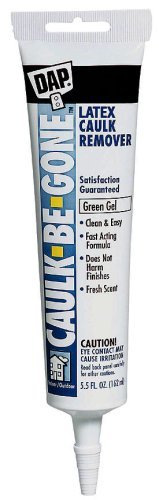
DAP Caulk-Be-Gone Odorless Gel Caulk Remover, 5.5 oz
An odorless gel for the perished caulk bead you have to get out before a new one will seal.
#ad · how we are funded · price as of October 17, 2026
Fitting it so it does not fall off in January
- 1Strip the old seal and clean off every trace of the old adhesive. This is the step that decides the job.
- 2Wipe the jamb with isopropyl alcohol and let it dry fully. Not household cleaner, which leaves a film.
- 3Work in a warm room. Most pressure-sensitive adhesives will not bond properly below about 50 F.
- 4Start at the top of the latch side and press as you go, without stretching the strip. Stretched seal pulls back off the corners within a week.
- 5Cut at the corners rather than bending a continuous strip around them.
- 6Close the door and check the latch. If the door will not close easily, your seal is too thick — that is a measurement error, not a fitting error.
Do the frame and the bottom in the same session. A sealed frame with an open gap under the door just moves the draft, and the two parts together cost about the same as one takeout meal. The bottom is covered in best door sweeps.
Questions people actually ask
- What is the best weather stripping for doors?
- For a measured gap of an eighth to a quarter inch, a hollow EPDM D-section is the best general answer: it publishes its section, seals across that band, and stays flexible in cold. For a hairline gap use a V-strip; for very cold climates, silicone.
- How do I stop a draft at the sides of my door?
- Self-adhesive weather stripping on the door stop — the raised lip the door closes against — not on the door itself. Clean the surface first, work above 50 F, and pick a thickness slightly larger than the gap you measured.
- Why does my weather stripping keep falling off?
- Almost always the surface, not the tape. Old adhesive residue, dust, bare wood, fresh paint or a cold room will all stop a pressure-sensitive adhesive bonding. Remove the residue with an adhesive remover, wipe with alcohol, dry, and fit in a warm room.
- What is the difference between V-seal and D-section weather stripping?
- A V-strip is a folded plastic tension seal that springs back after every close, so it suits thin, uneven gaps. A D-section is a hollow rubber tube that compresses, so it suits a larger and more consistent gap. V-strip is nearly invisible; D-section seals more air per foot.
- Can I put weather stripping on the door instead of the frame?
- On the sides and top, put it on the frame stop. On the door it gets caught on the strike plate and hinges. The exception is the bottom of the door, where an adhesive sweep does go on the door face.
Sources
- Frost King — weatherstripping product range and published sections
- fowong — published V-seal dimensions (1/2 in wide, 19 ft)
Every specification on this page traces to a published manufacturer or retailer listing. Where a maker publishes no working gap range, we say so rather than estimating one.
Read next
Foam, V-seal or silicone: which weather stripping your door needs
Three materials, three gap bands, one spec table. Choose by measured gap, not by shelf price.
The best door sweeps, sorted by the gap they actually close
Six sweeps placed by the gap they close, from a slim vinyl blade to a brush for uneven floors.
How to measure a door gap properly
The index-card method, the three-point rule, and how to read your number against a published seal size.
The best storm door sweeps, and why the brand on the door matters
Chosen by the channel it slides into, not the gap it closes. The Andersen and Larson OEM parts, the generic T-inserts, and how to tell which you need.
The best weather stripping for French doors and double doors
French doors leak down the middle, not the edges. Stop seals, astragal seals and a bottom for each leaf — and the free flush-bolt check that comes first.
The best weather stripping for steel doors, chosen by what your frame actually has
Check the frame for a kerf slot and the slab with a fridge magnet. Those two answers pick the part.
The best spring bronze weatherstripping, and whether you should be fitting it at all
Nailed bronze that outlasts everything and follows a gap that varies. Sized on width, then length.
Q-Lon weatherstrip replacement, and the one spec that decides whether it works
The strip most prehung doors shipped with. Reach is the spec, and matching it is the whole job.