04 / HIDDEN LEAKS
Cold air blowing from a return vent
The return is supposed to pull room air back to the furnace. When it delivers cold air instead, something upstream is letting outside air into the duct.
We earn a commission on some links here, at no extra cost to you. It does not change what we recommend or the order they appear in. How we are funded
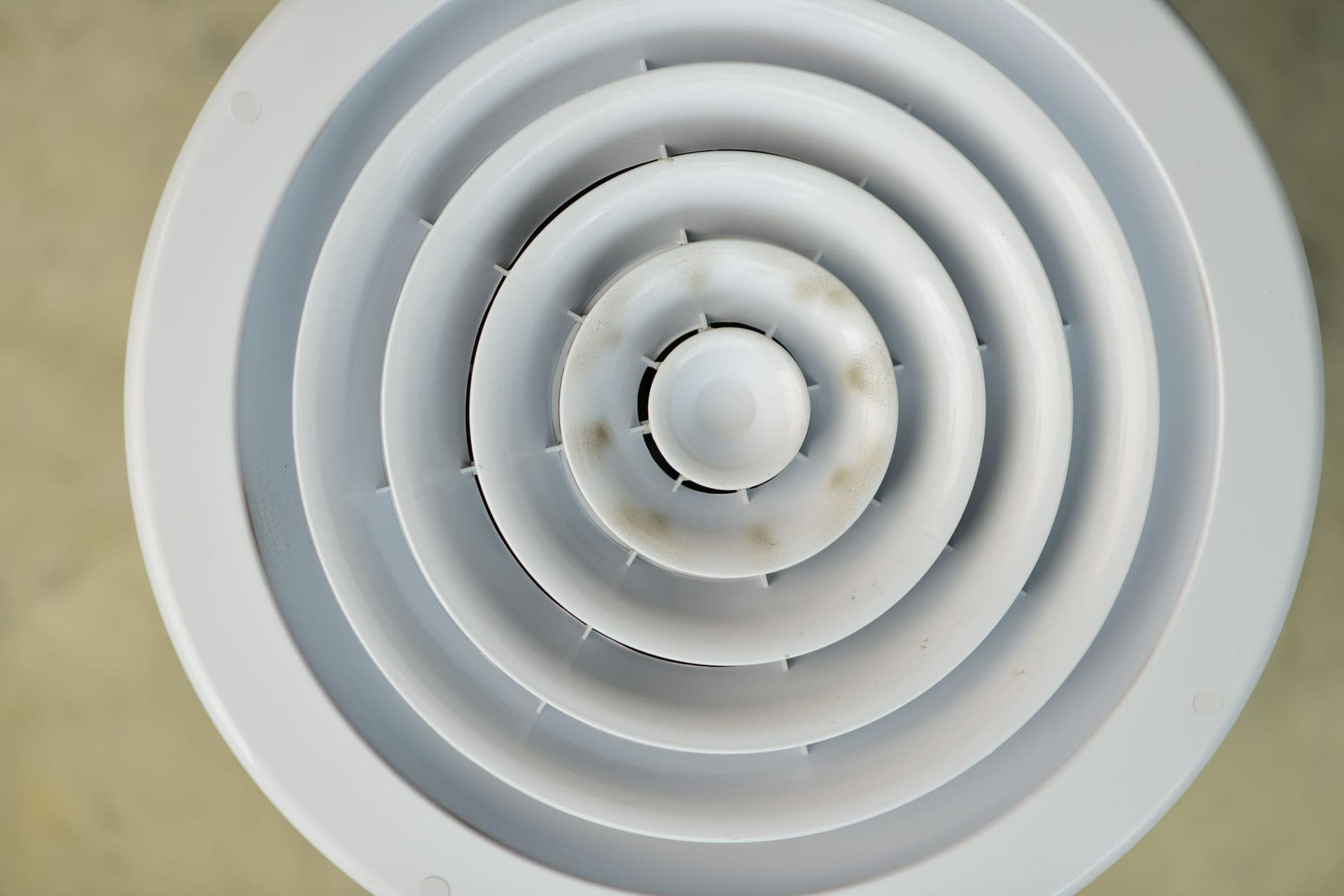
A return grille moves air toward the furnace, so it should not blow at all. If you feel cold air at one, either the system is off and you are feeling air falling through a duct that runs somewhere cold, or the return duct is drawing outside air in through unsealed joints. Seal the duct joints and the grille-to-wall gap; leave the equipment to an HVAC tech.
First, work out which vent you have
Hold a tissue against the grille with the system running. If it is pulled onto the grille, that is a return. If it is blown away, that is a supply. People often report a cold draft from a return when the vent is actually a supply delivering unheated air, and those are completely different problems.
| What you observe | What it usually means | Whose job |
|---|---|---|
| Cold air blows out of a SUPPLY vent while heating | A heating fault, or supply ducts running through a cold space | HVAC technician |
| Cold air falls out of a RETURN grille when the system is off | The return duct connects to somewhere cold and air is settling down it | Sealing — the duct joints and the grille |
| The return grille itself feels drafty around its edges | The gap between the grille frame and the wall or ceiling | Sealing — caulk the perimeter |
| A whistling return when the system runs | Undersized or restricted return, not an air leak | HVAC technician |
Why a return can deliver cold air at all
Return ducts are often the leakiest part of a heating system, because in a lot of houses they are not fully ducted at all — a joist bay or a wall cavity gets pressed into service as part of the return path, with sheet metal closing off the ends. Those cavities are not airtight, and they frequently connect to a basement, crawlspace or attic.
When the blower runs it pulls hard on that path, and anything the cavity connects to gets pulled in with the room air. When the blower stops, cold air that has collected in the duct simply falls back out of the nearest grille. Both are the same underlying problem: the return is connected to somewhere it should not be.
What you can seal yourself
- 1The grille perimeter. Take the grille off and look at the gap between its frame and the wall or ceiling opening. Caulk it, with backer rod first if it is deeper than about a quarter inch.
- 2Accessible duct joints. In a basement or crawlspace, joints in accessible return ductwork can be sealed with mastic or foil tape. Not cloth duct tape, which fails within a couple of years on ductwork.
- 3The boot-to-floor or boot-to-wall joint where the duct meets the opening it serves. This is a common and very reachable leak.
- 4Penetrations into the cavity if a joist bay is being used as a return and you can see daylight or feel air at its ends.
Where to stop
- Do not block or close a return grille. Starving the return raises static pressure, strains the blower and can cause the heat exchanger to cycle badly. It is not a draft fix, it is a way to break the system.
- Do not seal ductwork you cannot see the whole run of.
- Do not touch anything inside the furnace cabinet.
- Get a professional in if the return path runs through a garage, near a combustion appliance, or if you cannot tell where it draws from.
Quick picks
Ranked for fit, not for hype. Tap a row to jump to the full write-up, or go straight to the listing.
| # | Product | Best for | Gap range | Price |
|---|---|---|---|---|
| 1 |  Frost King C21CP-C Caulk Saver Backer Rod, 3/8 in x 350 ftBacker rod: the foam you push into a deep gap so the caulk over it is a seal rather than a bottomless hole. | Deep gaps before caulking | Published 3/8 in diameter; backs gaps of roughly 1/4 in to 1/2 in | $34.98 · CHECK ON AMAZON |
| 2 |  fowong Open Cell Foam Weather Stripping, 1 in x 1/2 in x 13 ftHalf-inch-thick open-cell foam for the gap nothing else reaches — an AC surround, a loose sash, a warped frame. | Large, irregular gaps | Published 1/2 in thick; fills gaps of roughly 1/8 in to 3/8 in | $16.99 · CHECK ON AMAZON |
#ad · how we are funded · price as of October 17, 2026
Deep gaps before caulking
Frost King C21CP-C Caulk Saver Backer Rod, 3/8 in x 350 ft
Published gap range
Published 3/8 in diameter; backs gaps of roughly 1/4 in to 1/2 in
#ad · how we are funded · price as of October 17, 2026
Backer rod: the foam you push into a deep gap so the caulk over it is a seal rather than a bottomless hole.
Where the number comes fromFrost King publishes the diameter (3/8") and length (350 ft). Backer rod is sized about 25% larger than the gap so it compresses in and stays put — a 3/8" rod suits a gap around 1/4" to 5/16".
- Published diameter
- 3/8 in
- Published length
- 350 ft
- Use
- Backing deep gaps before caulk
- Sizing rule
- Rod should be larger than the gap so it compresses in
- Color
- Gray
- Mounting
- Pressed into the gap ahead of the caulk
What it does well
- Stops you burning three tubes of caulk into one deep crack
- Gives the caulk the right two-sided bond instead of a three-sided one
- 350 ft is effectively a lifetime supply
Where it fails
- One diameter only — a wider gap needs a bigger rod
- Bulky roll to store
- Pointless on a gap shallow enough to caulk directly
Who this is forA gap deeper than about a quarter inch that you are about to caulk.
Large, irregular gaps
fowong Open Cell Foam Weather Stripping, 1 in x 1/2 in x 13 ft
Published gap range
Published 1/2 in thick; fills gaps of roughly 1/8 in to 3/8 in
#ad · how we are funded · price as of October 17, 2026
Half-inch-thick open-cell foam for the gap nothing else reaches — an AC surround, a loose sash, a warped frame.
Where the number comes fromfowong publishes 1" wide x 1/2" thick x 13 ft. Open-cell foam compresses much further than rubber, which is why it covers a wider range — and also why it is not a long-life exterior seal.
- Material
- PU foam, PE cover
- Published width
- 1 in
- Published thickness
- 1/2 in
- Published length
- 13 ft
- Mounting
- Strong adhesive
- Mounting
- Self-adhesive
What it does well
- Half an inch of squash covers gaps rubber sections cannot
- The PE facing sheds water better than bare foam
- Cheap enough to over-buy and cut down
Where it fails
- Open-cell foam holds water if the facing is cut or torn
- Shortest life of any seal here in direct weather
- Too thick for a door that latches tightly
Who this is forA portable-AC surround, a basement sash, or any gap you can push a finger into.
How we picked
- Separate the two things people mean by this complaint before recommending anything.
- State clearly where the line is between a sealing job and an HVAC job.
We have not tested these products and we do not claim to have. The full method, including what we refuse to claim, is on how we pick.
If the cold turns out to be coming from the room rather than the duct, the ordinary suspects are still the ordinary suspects — start with how to find drafts in your house.
Questions people actually ask
- Why is cold air coming from my return vent?
- Usually because the return duct connects to somewhere cold — a crawlspace, basement or attic — through unsealed joints or an unlined cavity. When the blower is off, that cold air falls back out of the grille.
- Should I close a return vent to stop the draft?
- No. Closing or blocking a return starves the system, raises static pressure and strains the blower. Seal the duct joints and the grille perimeter instead, and call an HVAC tech if you cannot find the source.
- What is the difference between a supply and a return vent?
- Hold a tissue to the grille with the system running: a supply blows it away, a return pulls it on. Cold air from a supply while heating is an equipment problem; cold air from a return is usually a duct sealing problem.
- Can I use duct tape on return ducts?
- Not cloth duct tape — it dries out and lets go within a couple of years on ductwork. Mastic or foil tape rated for ducts is what holds.
Sources
Every specification on this page traces to a published manufacturer or retailer listing. Where a maker publishes no working gap range, we say so rather than estimating one.
Read next
How to find drafts in your house
Five tests, no equipment, an hour — ordered so you find the big leaks before the small ones.
Spray foam, caulk or backer rod?
Three fillers, sorted by gap width and whether the joint moves. Including the backer-rod sizing rule.
Cold air coming up from under the house
Cold floors are usually the rim joist. The biggest accessible leak in a house, and rarely sealed.
The best fireplace and chimney draft stoppers
An open damper pumps heated air out all winter. Flue plugs, magnetic blankets, and the one safety rule that governs the whole category.