01 / DOORS
How long does weather stripping last?
Nobody notices weather stripping failing. It goes slowly, the room gets slowly colder, and the draft gets blamed on the window. Here is how to tell, and what to replace it with.
We earn a commission on some links here, at no extra cost to you. It does not change what we recommend or the order they appear in. How we are funded

It depends entirely on the type, and the spread is enormous: adhesive foam tape lasts one to three years, V-seal and compression bulb seals five to ten, and spring bronze or a kerf-fitted Q-Lon seal can run twenty or more. If yours is flattened, cracked, or no longer grips a sheet of paper, it is finished regardless of age — and the Q-Lon kerf kit is the replacement most exterior doors should get.
The honest service lives, by type
These are ranges, and they assume an exterior door or window in a climate with real winters. An interior door's seal lasts effectively forever because nothing is attacking it. South-facing, sun-baked, salt-air or desert installations sit at the short end of every range below.
| Type | Typical service life | What actually kills it | Replaced by |
|---|---|---|---|
| Open-cell adhesive foam tape | 1-3 years | Compression set — it is crushed flat and never recovers — plus adhesive failure | Like for like, or upgrade to V-seal |
| Closed-cell foam / rubber tape | 2-5 years | Adhesive lets go before the foam does, usually at a corner | Like for like, or V-seal |
| V-seal (tension seal), vinyl | 5-10 years | The V loses its spring and stops pushing back | V-seal |
| Compression bulb in a kerf (Q-Lon type) | 10-20 years | The foam core hardens and the skin splits at the hinge end | The same reach of kerf seal |
| Spring bronze | 20+ years | Almost nothing. It gets painted over or bent | Rarely needed; re-tension it |
| Door sweep, aluminum and rubber | 5-10 years | The blade abrades on the threshold, worst at the latch end | A new sweep, same gap band |
| Garage door bottom seal, EPDM | 5-10 years | Ultraviolet light and ozone cracking, plus being driven over | Same retainer profile |
| Garage door bottom seal, cheap PVC | 2-4 years | Goes hard in the first real cold snap and splits | Upgrade to EPDM |
The four tests, in order of how fast they are
You do not need to know how old the seal is. All four of these tell you about its condition now, which is the only thing that matters.
- 1The paper test, ten seconds. Close the door on a sheet of paper and pull. If it slides out with no resistance, the seal is not compressing at that point. Repeat at the top, middle and bottom of the latch side, then the hinge side. A seal that grips at the middle and releases at the top is the classic worn pattern, and it is the one people miss by testing in one place.
- 2The look test, thirty seconds. Run a finger along the seal. Flattened with a permanent groove in it, crumbling at the touch, shiny and hard where it should be matte and soft, or lifting at a corner — any one of those is a finished seal.
- 3The daylight test, one minute. Stand inside in daytime with the lights off and look at the whole frame. Light means a gap. This one also finds the gaps that were never sealed in the first place.
- 4The smoke test, five minutes. A lit incense stick moved slowly around the frame. The method is in how to find drafts in your house, and it is the only one of the four that tells you how much air is moving rather than just that a gap exists.
The paper test is the one to internalize, because it is the only test that measures the thing that matters — whether the seal is still being compressed — rather than whether a gap is visible.
Replace, or re-tension?
Two types are worth saving rather than replacing, and knowing which saves you a purchase.
Spring bronze does not wear out, it loses its set. The correct repair is to run a putty knife or a stiff blade under the free edge and lever it back out to its original angle, working along the whole run. A bronze strip that has been painted over is a different story: paint in the hinge of the spring stops it flexing, and no amount of levering recovers that. The whole subject is covered in best spring bronze weatherstripping.
A door that has dropped does not need a seal at all. If the paper test fails only at the top of the latch side, and the door has started catching on the threshold, the hinges have sagged — tighten the top hinge screws into longer screws that reach the stud, and the seal that looked finished starts working again. Replacing the weather stripping on a dropped door is the most common wasted purchase in this whole category.
Three honest warning signs that it is not the seal
- The draft is at the floor along a whole wall, not at the door. That is almost always the rim joist or the floor itself, and it has its own page: cold air coming up from under the house.
- Replacing it last year did not help. Suspect the gap was never the problem, or the part you fitted was too thin for the gap. How to measure a door gap is the step that gets skipped.
- The new seal stops the door latching. The part is too thick, not too good. A compression seal should be slightly thicker than the gap and not dramatically thicker, because a door that has to be shouldered shut will destroy both the seal and the latch inside a season.
Buying the replacement
The replacement is decided by what is already in your frame, not by what is best in the abstract. Pull a six-inch length of the old seal out and look at the end of it.
| What the old seal looks like | What it is | What to buy |
|---|---|---|
| A bulb with a flat fin that sits in a slot in the frame | Kerf-mounted compression seal | A kerf seal in the same reach — see Q-Lon weatherstrip replacement |
| A folded vinyl strip taped to the stop | V-seal / tension seal | V-seal, same width |
| A flat sponge strip with glue residue | Adhesive foam tape | V-seal is the upgrade; foam if you want like for like |
| A thin bronze or brass strip with nail holes | Spring bronze | Re-tension it first; replace only if painted or torn |
| A rubber blade in an aluminum carrier at the door bottom | Door sweep | A sweep covering your measured gap |
| A rubber bead or T in a track at the garage door bottom | Garage bottom seal | Match the retainer — see garage door bottom seals by brand |
Quick picks
Ranked for fit, not for hype. Tap a row to jump to the full write-up, or go straight to the listing.
| # | Product | Best for | Gap range | Price |
|---|---|---|---|---|
| 1 |  Q-Lon 96 in Replacement Kerf Weatherstrip Kit, Medium Reach, Beige, 3 PiecesThree matched strips for the hinge side, lock side and header, in the reach and color most prehung doors left the factory with. | A whole door in one order | Published as Medium Reach; sold as three 96 in strips | $39.95 · CHECK ON AMAZON |
| 2 | 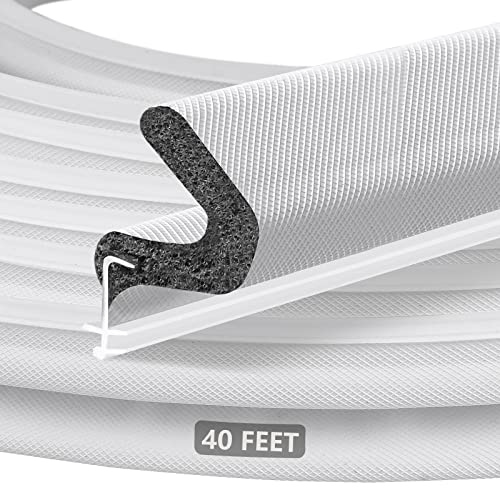 Litaibai Kerf Weather Stripping for Exterior Doors, 40 ft, WhitePlain kerf strip with no magnet — the cheap answer when the frame has the slot but the door is fiberglass or wood, where a magnetic seal has nothing to grip. | A kerfed frame on any door material | Not published as a gap range; published as a 40 ft roll | $19.99 · CHECK ON AMAZON |
| 3 |  M-D Building Products V-Flex Window Seal Weatherseal, 3/8 in x 17 ft, WhiteV-strip folds into the gap and springs back, so it seals a jamb that never closes to exactly the same place twice. | Door and window frame sides | Published 3/8 in wide x 17 ft; M-D publishes no gap range | $8.62 · CHECK ON AMAZON |
| 4 |  Frost King A79WHA Premium Aluminum and Reinforced Rubber Door Sweep, 2 x 36 in, WhiteA screw-on aluminum carrier with a reinforced rubber blade — the version of this part that survives a winter of a storm door slamming into it. | Exterior doors, screw-mounted | Roughly 1/4 in to 3/4 in | CHECK PRICE |
| 5 |  Holikme Garage Door Bottom Seal, EPDM Rubber, 22 ft, for 5/16 in Double T-TrackA straightforward EPDM U-and-O profile for a 5/16 in double T-track retainer. It is the honest baseline on both of this site's garage seal pages: good at weather, not a rodent barrier, and priced accordingly. | The plain weather job, when rodents are not the problem | Fits a 5/16 in double T-track retainer; the U+O profile closes the floor gap it is sized for | $32.99 · CHECK ON AMAZON |
#ad · how we are funded · price as of October 17, 2026
A whole door in one order
Q-Lon 96 in Replacement Kerf Weatherstrip Kit, Medium Reach, Beige, 3 Pieces
Published gap range
Published as Medium Reach; sold as three 96 in strips
#ad · how we are funded · price as of October 17, 2026
Three matched strips for the hinge side, lock side and header, in the reach and color most prehung doors left the factory with.
Where the number comes fromREACH is the specification that decides whether this works, and it is the one almost nobody checks. Reach is how far the foam bulb stands out of the kerf slot to meet the door. Too short and the door shuts on nothing; too long and it will not latch without a shove. Medium is the common factory fitment. Pull a short length of your old strip out and compare it against the published reach before ordering, rather than after.
- Published reach
- Medium
- Pieces
- 3 — hinge, lock, header
- Published length
- 96 in per strip
- Color
- Beige
- Listed fitment
- Masonite, Jeld-Wen, Taylor entry doors
- Mounting
- Barbed spine pushed into the kerf slot in the frame
What it does well
- Covers a whole door in one order, with all three runs matched in reach and color
- Publishes the reach, which is the spec that actually governs fit and which generic kerf strip omits
- 96 in per strip covers a standard 80 in jamb with spare for the header
Where it fails
- Beige is wrong against a white frame and this material does not take paint
- Medium reach is a guess if you have not pulled your old strip out to check
- Costs appreciably more than generic kerf bulb strip sold by the roll
Who this is forA prehung entry door whose original Q-Lon has gone hard all the way round.
A kerfed frame on any door material
Litaibai Kerf Weather Stripping for Exterior Doors, 40 ft, White
Published gap range
Not published as a gap range; published as a 40 ft roll
#ad · how we are funded · price as of October 17, 2026
Plain kerf strip with no magnet — the cheap answer when the frame has the slot but the door is fiberglass or wood, where a magnetic seal has nothing to grip.
Where the number comes fromKerf strip is chosen by the slot, not the gap: the barbed spine pushes into the machined groove and the bulb stands proud to meet the door. Published at 40 ft, which covers a standard door perimeter roughly twice. Test-fit a short piece before cutting the roll — kerf widths are not fully standard and a spine that is too slim will work loose.
- Published length
- 40 ft
- Mounting
- Kerf slot
- Seal
- Bulb
- Magnetic
- No
- Finish
- White
- Mounting
- Barbed spine pushed into the kerf slot
What it does well
- By far the cheapest per foot of the kerf options here
- Works on any door material, because it does not rely on a magnet
- 40 ft does a door perimeter about twice, so a second door or a mistake is covered
Where it fails
- No magnetic pull, so the seal is only as tight as the latch holds the door
- Kerf widths vary between frame makers and the listing publishes no spine dimension
- Unbranded reseller listing with no maker data sheet
Who this is forA kerfed prehung frame with a fiberglass or wood slab.
Door and window frame sides
M-D Building Products V-Flex Window Seal Weatherseal, 3/8 in x 17 ft, White
Published gap range
Published 3/8 in wide x 17 ft; M-D publishes no gap range
#ad · how we are funded · price as of October 17, 2026
V-strip folds into the gap and springs back, so it seals a jamb that never closes to exactly the same place twice.
Where the number comes fromM-D publishes the strip width (3/8 in) and the roll length (17 ft), not a gap range. Our reasoning, stated as reasoning: a V-strip is folded along its crease and stands off roughly half its flat width, so a 3/8 in strip suits a hairline gap up to somewhere around 1/8 in. Past that it stops making contact and you want a bulb or D-section instead.
- Profile
- V (tension) strip
- Published width
- 3/8 in
- Published length
- 17 ft
- Mounting
- Self-adhesive
- Color
- White
- Mounting
- Self-adhesive, folded along the crease onto the jamb
What it does well
- Springs back after every close, so it keeps sealing as the door settles
- Nearly invisible once the door is shut
- A named manufacturer that publishes the width, which most V-strip listings do not
Where it fails
- 17 ft only just covers one standard door frame, so there is very little margin for a mis-cut
- Narrower than the 1/2 in strips, so it reaches a smaller gap
- Adhesive fails on rough, dusty or freshly painted wood
Who this is forThe sides and top of a door or a double-hung window, where the gap is thin and uneven.
Exterior doors, screw-mounted
Frost King A79WHA Premium Aluminum and Reinforced Rubber Door Sweep, 2 x 36 in, White
Published gap range
Roughly 1/4 in to 3/4 in
#ad · how we are funded · price as of October 17, 2026
A screw-on aluminum carrier with a reinforced rubber blade — the version of this part that survives a winter of a storm door slamming into it.
Where the number comes fromFrost King does not publish a numeric working range for this sweep. The 2-inch face and the rubber blade's projection put it in the quarter-inch-to-three-quarter-inch band once mounted; the blade must touch the threshold under light compression, not bend flat. Measure before you buy.
- Carrier
- Aluminum
- Blade
- Reinforced rubber
- Published size
- 2" x 36"
- Mounting
- Screws (supplied)
- Maker's claim
- Lifetime guarantee on weathersealing ability
- Mounting
- Screws through the door face, above the threshold
What it does well
- Screws, not adhesive — nothing to peel off in July
- Cuts down with a hacksaw for a narrower door
- The rubber blade is replaceable in practice; the carrier is what lasts
Where it fails
- You are drilling into the door face — renters should look at an adhesive or slide-on option
- No published gap range, so measuring first is not optional
- The matte white profile vanishes on white trim and stands out on a stained or dark door
Who this is forAn exterior door you own, with a gap you can see daylight through and a threshold that is basically flat.
The plain weather job, when rodents are not the problem
Holikme Garage Door Bottom Seal, EPDM Rubber, 22 ft, for 5/16 in Double T-Track
Published gap range
Fits a 5/16 in double T-track retainer; the U+O profile closes the floor gap it is sized for
#ad · how we are funded · price as of October 17, 2026
A straightforward EPDM U-and-O profile for a 5/16 in double T-track retainer. It is the honest baseline on both of this site's garage seal pages: good at weather, not a rodent barrier, and priced accordingly.
Where the number comes fromThe published specification that matters is the RETAINER, not the gap: 5/16 in double T-track. If your retainer takes a round bead or a single T, this does not fit, and no amount of force will make it.
- Retainer fit
- 5/16 in double T-track
- Profile
- U + O, per the listing
- Material
- EPDM rubber
- Length
- 22 ft
- Blocks
- Rain, snow, drafts, dust and debris, per the listing
- Mounting
- Slides into an existing 5/16 in double T-track retainer
What it does well
- EPDM stays flexible in cold far better than the cheap PVC seals sold at the same price
- 22 ft covers a single 16 ft door with offcuts left for a second attempt
- Explicitly publishes the retainer it fits, which is the single most common buying mistake in this category
Where it fails
- Plain rubber: a rodent chews through it, and the listing does not pretend otherwise
- Only fits one retainer profile, so it is useless if yours is a bead
- You still need the floor to be flat enough for a bulb seal to meet it
Who this is forAnyone replacing a worn bottom seal on a door that already has a double T-track retainer.
When to do it
Early autumn, for a practical reason rather than a seasonal one: adhesive-backed seals need a surface above roughly 50 degrees Fahrenheit to bond properly, and compression seals are easier to size when the frame is not swollen or shrunk to an extreme. Fitting adhesive weather stripping to a cold frame in January is the single most common reason it falls off in February.
And do the whole opening at once. Replacing the latch-side seal because that is the one that failed, while leaving a twelve-year-old hinge-side seal in place, means doing the job twice. The sequence for a whole door is in best weather stripping for doors.
How we picked
- The service lives below come from published manufacturer guidance and material properties, not from our own observation. Where a maker publishes no expected life — which is most of them — we say that and reason from the material instead.
- We publish no test of our own. We have not aged any of these products, and anyone quoting you a precise number of winters for a specific brand is guessing.
- The replacement picks are chosen by what you already have in the frame, because that is what decides which part fits. The full method is published.
We have not tested these products and we do not claim to have. The full method, including what we refuse to claim, is on how we pick.
Questions people actually ask
- How long does weather stripping last on an exterior door?
- Five to ten years for a V-seal or compression bulb, one to three for adhesive foam tape, and ten to twenty for a kerf-fitted bulb seal of the Q-Lon type. Spring bronze outlasts all of them. No manufacturer publishes a figure, because service life depends on door cycles, compression and sun exposure.
- How do I know if my weather stripping is bad?
- Close the door on a sheet of paper and pull it out. If it slides free with no resistance, the seal is not compressing at that point. Test the top, middle and bottom of both sides — a seal that grips in the middle and releases at the top is the normal wear pattern, and testing one spot misses it.
- How often should weather stripping be replaced?
- By condition, not by calendar. Run the paper test each autumn and replace what fails. If you want a rule of thumb: assume adhesive foam is a two-year consumable, and assume a good compression seal will outlast the next time you repaint the door.
- What does worn-out weather stripping look like?
- Flattened with a permanent groove down the middle, hard and shiny where it used to be soft and matte, cracked across its width, crumbling when you rub it, or lifting away from the frame at a corner. Any one of those means it has stopped compressing.
- Why did my new weather stripping stop the door closing?
- It is thicker than the gap can accept. A compression seal should be slightly thicker than the gap, not dramatically thicker. Measure the frame gap with folded index cards, buy against that number, and if the door now needs shouldering shut, fit a thinner profile rather than living with it.
- Can I just add new weather stripping over the old?
- No. The old seal is already compressed flat, so the new one sits on a hard uneven base and cannot compress evenly, and adhesive will not bond reliably to aged rubber. Pull the old run out, clean the surface back to the frame, then fit.
- Does weather stripping go bad if the door is never used?
- Slower, but yes. A seal held under constant compression without ever being released takes a permanent set, and ultraviolet light keeps working on the exposed face either way. A door that is never opened often has the most convincingly flattened seal in the house.
Sources
- U.S. Department of Energy - published guidance on weatherstripping types and selection
- U.S. Department of Energy - published guidance on air sealing and caulking around doors and windows
Every specification on this page traces to a published manufacturer or retailer listing. Where a maker publishes no working gap range, we say so rather than estimating one.
Read next
The best weather stripping for doors, by published thickness
V-strip, D-section, silicone and foam placed against the gap each published thickness can actually seal.
Q-Lon weatherstrip replacement, and the one spec that decides whether it works
The strip most prehung doors shipped with. Reach is the spec, and matching it is the whole job.
How to measure a door gap properly
The index-card method, the three-point rule, and how to read your number against a published seal size.
The best spring bronze weatherstripping, and whether you should be fitting it at all
Nailed bronze that outlasts everything and follows a gap that varies. Sized on width, then length.
How to find drafts in your house
Five tests, no equipment, an hour — ordered so you find the big leaks before the small ones.
Garage door bottom seals by brand, and what universal really means
Clopay takes a T-end, Wayne Dalton a round bead, and they do not swap. Read your retainer in ten seconds.