05 / ATTIC
Attic tent or a DIY insulated box?
Both close the hole. One takes twenty minutes and a credit card, the other takes an afternoon and seals better on the opening it suits.
We earn a commission on some links here, at no extra cost to you. It does not change what we recommend or the order they appear in. How we are funded

A bought tent suits pull-down stairs, where the mechanism needs clearance and a rigid box will not fit. A DIY rigid box suits a scuttle hatch, where there is nothing moving and a box can sit tight over the panel. On the opening each suits, both work; used on the wrong one, neither does.
| Bought tent | DIY rigid box | |
|---|---|---|
| Suits | Pull-down stairs | Scuttle hatch, no moving parts |
| Time | Under an hour | An afternoon plus materials run |
| Published R-value | Sometimes, on the better ones | None — you choose the board, so you own the spec |
| Access | Zipper | Lift the box off, which is a two-hand job in a loft |
| Seals the perimeter? | No | No — both leave that to weatherstrip |
| Fits an odd opening | Only if a size exists | Yes — you cut it to the hole you have |
| Cost | Low to moderate | Depends entirely on board choice |
Why the opening type decides it
A pull-down stair assembly moves. The door swings down, the ladder unfolds, and the springs and arms sweep through a volume above the opening. A rigid box built over that volume will foul the mechanism — so the answer there is a fabric tent that can be unzipped and pushed aside.
A scuttle hatch does not move. It is a panel that lifts out. There is nothing to foul, so you can build a tight rigid box around the opening and lift it off when you need access. That is why the DIY route is genuinely competitive here and genuinely wrong on pull-down stairs.
If you build one, the things that decide whether it works
- Seal the seams. A box with open corner joints is a box with a hole in it. Tape or caulk every seam.
- Seal it to the ceiling, or weatherstrip the hatch frame. A box resting loose on a dusty attic floor leaks around its base.
- Keep it clear of [recessed lights](/attic/best-recessed-light-covers) and any flue. This is the safety constraint that governs everything you build up there.
- Make it liftable by one person, from a ladder. A box you dread moving is a box that gets left off.
- Do not claim an R-value you have not looked up. If you want a number, read the one printed on the board you bought and use that.
Pick this if
- You have pull-down stairs — a tent. A box will foul the mechanism.
- You have a scuttle hatch and basic tools — a box, cut to your actual opening.
- Your opening is a non-standard size — a box, because you cut it to fit rather than hunting a product that matches.
- You want a published spec you can compare — a bought tent that states its R-value.
- You want it done today — a bought cover, and do the perimeter weatherstrip at the same time.
Quick picks
Ranked for fit, not for hype. Tap a row to jump to the full write-up, or go straight to the listing.
| # | Product | Best for | Gap range | Price |
|---|---|---|---|---|
| 1 |  Miloo Attic Door Insulation Cover, 25 x 54 x 11 in, R-15.6A zippered tent over the whole stair opening with an R-value actually printed on the listing — which most of this category does not publish at all. | Pull-down stairs, published R-value | Fits a published 25 x 54 in opening, 11 in tall | $59.99 · CHECK ON AMAZON |
| 2 | 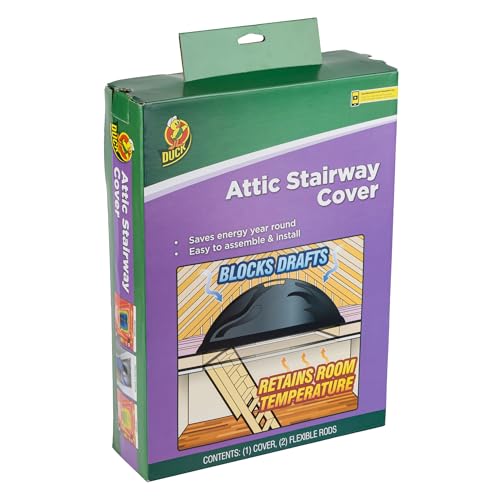 Duck Brand Attic Stairway Cover, fits 25.5 x 54 in openingsA lightweight cover that seals the stair opening without pretending to be insulation — and Duck, to its credit, publishes no R-value for it. | The cheapest cover that closes the opening | Fits openings up to a published 25.5 x 54 in | $54.98 · CHECK ON AMAZON |
| 3 |  Frost King EPDM Rubber Self-Stick Weatherseal Tape, D-Section, 5/16 in x 1/4 in x 17 ftEPDM in a hollow D — the profile that keeps sealing at minus ten where foam tape has already gone hard. | Medium frame gaps | Published 1/4 in thick; compresses to seal gaps of roughly 1/8 in to 1/4 in | $7.69 · CHECK ON AMAZON |
#ad · how we are funded · price as of October 17, 2026
Pull-down stairs, published R-value
Miloo Attic Door Insulation Cover, 25 x 54 x 11 in, R-15.6
Published gap range
Fits a published 25 x 54 in opening, 11 in tall
#ad · how we are funded · price as of October 17, 2026
A zippered tent over the whole stair opening with an R-value actually printed on the listing — which most of this category does not publish at all.
Where the number comes fromMiloo publishes the full box dimensions (25 x 54 x 11 in) and an R-value of 15.6. Measure your rough opening, not your stair door: the tent has to sit over the frame, so an opening larger than 25 x 54 in will not close.
- Published R-value
- 15.6
- Published size
- 25" x 54" x 11"
- Access
- Zipper
- Fits
- Pull-down ladder / stair openings
- Fire
- Listed as "fire proof" by the seller — see cons
- Mounting
- Sits over the opening in the attic, sealed to the frame
What it does well
- Publishes an R-value, which most of this category does not
- The zipper means you can still use the stairs without dismantling anything
- Covers the whole opening rather than just the hatch panel
Where it fails
- The "fire proof" wording is the seller's and names no standard or test; treat it as a marketing claim, not a rating
- One size only — a larger rough opening rules it out entirely
- You are installing it from inside the attic, which is the least pleasant part of this job
- A tent seals the opening; it does nothing for the hatch panel's own perimeter gap
Who this is forA standard 25 x 54 in pull-down stair opening where you want a number to compare.
The cheapest cover that closes the opening
Duck Brand Attic Stairway Cover, fits 25.5 x 54 in openings
Published gap range
Fits openings up to a published 25.5 x 54 in
#ad · how we are funded · price as of October 17, 2026
A lightweight cover that seals the stair opening without pretending to be insulation — and Duck, to its credit, publishes no R-value for it.
Where the number comes fromDuck publishes the opening it fits (25.5 x 54 in) and describes the cover as "flexible and lightweight". It publishes NO R-value, which is the honest position for a product of this construction — this is an air seal, not an insulator.
- Published fit
- 25.5" x 54" openings
- Published R-value
- None — Duck does not claim one
- Construction
- Flexible, lightweight
- Access
- Repositionable
- Job it does
- Air sealing, not insulating
- Mounting
- Assembled and placed over the opening; repositionable for access
What it does well
- The lowest-priced of the covers here
- Duck publishes no R-value rather than inventing one, which is more than several competitors manage
- Repositionable, so attic access stays genuinely usable
Where it fails
- It is an air seal, not insulation — do not expect it to perform like the R-rated tents
- Plastic sheet construction is the least durable here
Who this is forSomeone whose attic opening is currently sealed by nothing at all and who wants that fixed cheaply this weekend.
Medium frame gaps
Frost King EPDM Rubber Self-Stick Weatherseal Tape, D-Section, 5/16 in x 1/4 in x 17 ft
Published gap range
Published 1/4 in thick; compresses to seal gaps of roughly 1/8 in to 1/4 in
#ad · how we are funded · price as of October 17, 2026
EPDM in a hollow D — the profile that keeps sealing at minus ten where foam tape has already gone hard.
Where the number comes fromFrost King publishes the section dimensions exactly: 5/16" wide by 1/4" thick, 17 ft long. A hollow D seals across roughly half to full its stated thickness, which is where the 1/8-1/4 in working figure comes from.
- Profile
- Hollow D
- Published width
- 5/16 in
- Published thickness
- 1/4 in
- Published length
- 17 ft
- Material
- EPDM rubber
- Mounting
- Self-adhesive onto the door stop
What it does well
- EPDM stays flexible in cold, which is the entire point of a winter seal
- Published dimensions to three fractions — you can actually match it to a measurement
- Compresses without taking a permanent set the way open-cell foam does
Where it fails
- 17 ft is one door frame; a house needs several rolls
- Adhesive still needs a clean, smooth surface
- Thicker than a V-strip, so it can stop a tight door from latching
Who this is forA door stop or window sash with a visible, consistent gap you have measured.
How we picked
- Compare by what each option physically seals and on which opening type, not by which is cheaper in the abstract.
- Be explicit that the DIY route has no published R-value because you are choosing the materials yourself.
We have not tested these products and we do not claim to have. The full method, including what we refuse to claim, is on how we pick.
Ranked product picks are in best attic hatch and stair covers, and the opening-type question is covered in more detail in pull-down stairs vs a scuttle hatch.
Questions people actually ask
- Is a DIY attic hatch box better than a bought tent?
- On a scuttle hatch, often yes — you cut it to your exact opening and choose the board. On pull-down stairs, no: a rigid box fouls the moving stair mechanism, and a fabric tent is the right answer.
- What do I build an attic hatch box out of?
- Rigid insulation board with taped seams is the usual approach. Whatever you choose, read the R-value printed on the board rather than assuming one, and keep the finished box clear of recessed lights and any flue.
- Do I still need weatherstripping if I build a box?
- Yes. A box over the opening does not close the joint where the hatch panel rests on its frame. That joint is a direct air path and it takes weatherstrip.
Sources
Every specification on this page traces to a published manufacturer or retailer listing. Where a maker publishes no working gap range, we say so rather than estimating one.
Read next
The best attic hatch and pull-down stair covers
Covers and stair tents by published size and R-value — including the one whose maker honestly publishes none.
Pull-down stairs or a scuttle hatch: which do you have?
Two access types, two different products. Which you have decides everything else in this section.
Weatherstripping an attic hatch
The perimeter joint no cover closes — which seal, how thick, and why the latch matters as much as the strip.
Is an insulated attic ladder worth it, or should you just cover the one you have?
A sixty-dollar cover beats a several-hundred-dollar ladder for almost everyone. The one case where replacing wins, and what to buy either way.