05 / ATTIC
The best whole house fan covers for winter
The louvers close under their own weight and seal against nothing. For four months of the year that is a three-by-four-foot opening straight into the roof space.
We earn a commission on some links here, at no extra cost to you. It does not change what we recommend or the order they appear in. How we are funded

Measure the outside of the louver frame, not the ceiling opening, and buy a cover published to that size. The louver blades seal against nothing on their own — they hang closed under their own weight — so from October to April the shutter is an open hole into the roof space.
A hole you can see the attic through
A whole-house fan is a big propeller mounted in the ceiling of a landing or hallway, drawing air out of the house and pushing it into the roof space. On a summer evening it is an excellent thing to own — it will change the air in a house in minutes for a fraction of what air conditioning costs.
What is underneath it for the rest of the year is the problem. The fan sits behind a louvered shutter, typically three feet by four, and those louvers are hinged blades that fall closed when the fan stops. They rest against a bare metal frame. There is no gasket, no compression and no seal — if there were, the fan would have to fight it every time it started.
So for the whole heating season there is an unsealed opening of roughly twelve square feet in the ceiling, positioned in the hallway, which is exactly where warm air collects on its way up through a house. It is one of the largest single air leaks a home can have and it is completely invisible unless you go looking.
Above or below: where the cover goes
Covers are fitted either over the shutter from inside the attic, or against the ceiling from the room below, and both are sold in this category.
- From the attic — the cover sits over the whole housing. This is the better seal, it is invisible from the house, and it puts the insulated layer on the cold side where it belongs. It means getting into the roof space, and it means remembering it is there.
- From the room below — the cover fixes over the visible louver on the ceiling. Much easier to fit and, crucially, impossible to forget in April because you are looking at it. It is also visible all winter, which some people mind.
Our honest view: if you have ever forgotten a seasonal job in this house, fit from below. The seal is slightly worse and the risk of running the fan into a blocked shutter is much lower. An invisible cover in a dark attic is the one people find in July.
Match the part to your gap
Measure at the widest point. Then read across. If your measurement sits on a boundary, take the larger band — a seal that is slightly too big compresses, and one that is too small does nothing at all.
| Your gap | Part type | Our pick | Price |
|---|---|---|---|
| Shutter up to 36 x 48 in | Branded insulated cover | 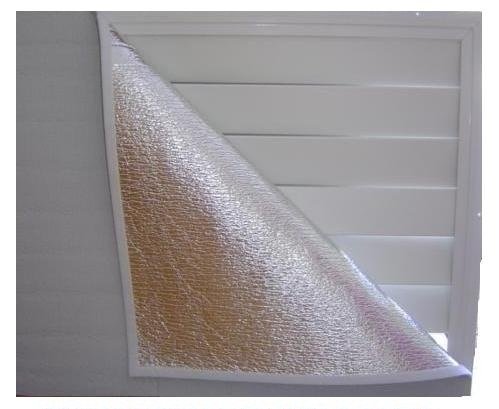 Battic Door Whole House Attic Fan Shutter Seal Cover, fits up to 36 x 48 inAn established maker with a published maximum shutter size, in a category otherwise full of unbranded fabric. | $63.99 · CHECK ON AMAZON |
| Same size, tougher shell | Oxford cloth cover, cotton fill |  EcoBrisa Whole House Attic Fan Cover, 36 x 48 in, Oxford ClothPublishes its shell material, which most covers do not. A part that gets folded and stored needs that. | $26.99 · CHECK ON AMAZON |
| Shutter up to 38 x 46 in | Insulated fabric cover |  Attic Fan Insulation Cover, fits up to 38 x 46 inThe published width the 36 in covers cannot reach. Measure the louver frame, not the ceiling opening. | $24.99 · CHECK ON AMAZON |
| Standard shutter, tight budget | Self-adhesive fabric cover | 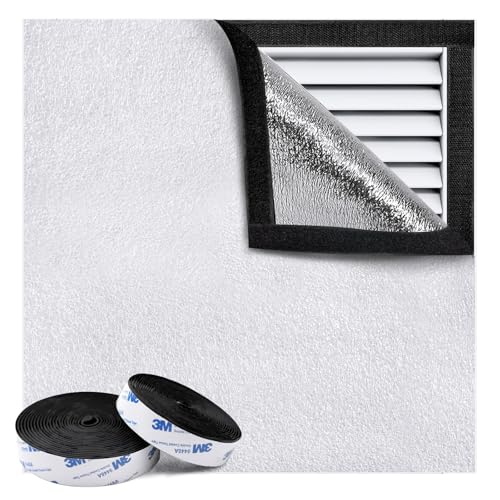 EcoBrisa Attic Fan Cover, 36 x 48 in, Self-AdhesiveCheapest way to close a 36 x 48 shutter. The adhesive strips are the compromise. | $16.49 · CHECK ON AMAZON |
Measuring the shutter
One measurement, taken in two directions, and it is not the one most people take. You want the outside dimensions of the louver frame — the metal surround the blades hang in — at its widest points. Not the fan. Not the plasterboard opening.
Covers publish a maximum: fits up to 36 by 48 in, or up to 38 by 46. Those are ceilings, not targets, so a 34 by 44 frame is fine under a 36 by 48 cover. What does not work is a frame larger in either direction than the published maximum, and shutters vary more than the round numbers suggest.
The picks
Quick picks
Ranked for fit, not for hype. Tap a row to jump to the full write-up, or go straight to the listing.
| # | Product | Best for | Gap range | Price |
|---|---|---|---|---|
| 1 | Battic Door Whole House Attic Fan Shutter Seal Cover, fits up to 36 x 48 inBattic Door has been making energy-conservation covers for this exact opening for years, and this is the one with a published maximum shutter size. | The established name in the category | Not a gap product — a cover over the fan shutter opening | $63.99 · CHECK ON AMAZON |
| 2 | EcoBrisa Whole House Attic Fan Cover, 36 x 48 in, Oxford ClothThe same 36 x 48 fit in oxford cloth with a cotton fill, which is a meaningfully more durable shell than the thin fabric covers. | A tougher fabric at the same size | Not a gap product — sized to the shutter | $26.99 · CHECK ON AMAZON |
| 3 | Attic Fan Insulation Cover, fits up to 38 x 46 inPublished at 38 x 46 in, which catches the shutters that are an inch or two beyond the common 36 x 48 fit. | A shutter slightly too wide for the others | Not a gap product — sized to the shutter | $24.99 · CHECK ON AMAZON |
| 4 | EcoBrisa Attic Fan Cover, 36 x 48 in, Self-AdhesiveThe budget entry, published at the common 36 x 48 size and fitted with self-adhesive strips rather than a frame. | The cheapest way to close the shutter | Not a gap product — sized to the shutter | $16.49 · CHECK ON AMAZON |
| 5 |  Frost King EPDM Rubber Self-Stick Weatherseal Tape, D-Section, 5/16 in x 1/4 in x 17 ftEPDM in a hollow D — the profile that keeps sealing at minus ten where foam tape has already gone hard. | Medium frame gaps | Published 1/4 in thick; compresses to seal gaps of roughly 1/8 in to 1/4 in | $7.69 · CHECK ON AMAZON |
#ad · how we are funded · price as of October 17, 2026
The established name in the category
Battic Door Whole House Attic Fan Shutter Seal Cover, fits up to 36 x 48 in
Published gap range
Not a gap product — a cover over the fan shutter opening
#ad · how we are funded · price as of October 17, 2026
Battic Door has been making energy-conservation covers for this exact opening for years, and this is the one with a published maximum shutter size.
Where the number comes fromA whole-house fan shutter is a louver in the ceiling that opens straight into the attic. In winter it is one of the largest single holes in the house, and the louver blades do not seal. This cover is fitted over the shutter from the room side or the attic side, and is sized by the SHUTTER, not by a gap: published here as fitting up to 36 x 48 in.
- Published maximum fit
- 36 x 48 in shutters
- Maker
- Battic Door
- Covers
- Whole house / attic ceiling fan shutter
- Seasonal
- Winter; removed before the fan runs
- Published R-value
- None claimed on the listing
- Mounting
- Fitted over the fan shutter opening
What it does well
- An established maker in a category otherwise full of unbranded fabric
- Publishes a maximum shutter size, which is the buying spec
- Addresses an opening most draft advice never mentions
Where it fails
- **The fan must not be run with the cover fitted** — this is a seasonal part and forgetting it is a real risk
- Costs two to three times the fabric covers
- No published R-value, so the benefit is air sealing rather than a stated insulation gain
Who this is forA house with a whole-house fan that is not used from October to April.
A tougher fabric at the same size
EcoBrisa Whole House Attic Fan Cover, 36 x 48 in, Oxford Cloth
Published gap range
Not a gap product — sized to the shutter
#ad · how we are funded · price as of October 17, 2026
The same 36 x 48 fit in oxford cloth with a cotton fill, which is a meaningfully more durable shell than the thin fabric covers.
Where the number comes fromPublished at 36 x 48 in with an oxford cloth shell over a cotton fill and self-adhesive fixing. Oxford cloth is a tighter weave than the plain fabric used on the cheapest covers, which matters for a part that gets folded and stored for six months a year.
- Published size
- 36 x 48 in
- Shell
- Oxford cloth
- Fill
- Cotton
- Fixing
- Self-adhesive
- Published R-value
- None claimed
- Mounting
- Self-adhesive strips around the shutter opening
What it does well
- A published shell material, which most covers in this category do not state
- Still well below the price of the branded cover
- Cotton fill gives it body, so it hangs flat against the ceiling
Where it fails
- Same adhesive-fixing compromise as the cheaper EcoBrisa cover
- No published R-value despite the insulation language
- Bulkier to store than a thin cover
Who this is forA standard shutter where the cheapest cover has already worn out once.
A shutter slightly too wide for the others
Attic Fan Insulation Cover, fits up to 38 x 46 in
Published gap range
Not a gap product — sized to the shutter
#ad · how we are funded · price as of October 17, 2026
Published at 38 x 46 in, which catches the shutters that are an inch or two beyond the common 36 x 48 fit.
Where the number comes fromPublished as fitting up to 38 x 46 in. Whole-house fan shutters are not standardized as tightly as people expect, so measure the louver frame itself — not the fan, and not the ceiling opening — before choosing between this and the 36 x 48 covers.
- Published maximum fit
- 38 x 46 in
- Construction
- Insulated fabric
- Covers
- Attic fan shutter
- Seasonal
- Winter only
- Published R-value
- None claimed
- Mounting
- Fitted over the fan shutter
What it does well
- A published width the 36 in covers do not reach
- Well under half the price of the branded cover
- Light enough to fit and remove single-handed
Where it fails
- Unbranded reseller listing with no maker's data behind it
- Fabric construction is the least durable option here
- Same seasonal hazard: the fan must not run with it fitted
Who this is forA wider shutter where the standard covers come up short.
The cheapest way to close the shutter
EcoBrisa Attic Fan Cover, 36 x 48 in, Self-Adhesive
Published gap range
Not a gap product — sized to the shutter
#ad · how we are funded · price as of October 17, 2026
The budget entry, published at the common 36 x 48 size and fitted with self-adhesive strips rather than a frame.
Where the number comes fromPublished at 36 x 48 in with self-adhesive fixing and described as reusable. Adhesive fixing is the compromise: it makes fitting trivial and makes a clean seal around the edge harder, because the tape is doing the sealing rather than a compressed gasket.
- Published size
- 36 x 48 in
- Fixing
- Self-adhesive strips
- Published reusable
- Yes
- Covers
- Whole house fan shutter
- Published R-value
- None claimed
- Mounting
- Self-adhesive strips around the shutter opening
What it does well
- Lowest verified price for closing a 36 x 48 shutter
- Self-adhesive fitting needs no tools and no frame
- Published as reusable, so it survives being taken down each spring
Where it fails
- Adhesive strips on a painted ceiling can pull the paint when removed
- The seal is only as good as the tape line around the edge
- Unbranded listing with no maker specification
Who this is forA standard shutter and a tight budget.
Medium frame gaps
Frost King EPDM Rubber Self-Stick Weatherseal Tape, D-Section, 5/16 in x 1/4 in x 17 ft
Published gap range
Published 1/4 in thick; compresses to seal gaps of roughly 1/8 in to 1/4 in
#ad · how we are funded · price as of October 17, 2026
EPDM in a hollow D — the profile that keeps sealing at minus ten where foam tape has already gone hard.
Where the number comes fromFrost King publishes the section dimensions exactly: 5/16" wide by 1/4" thick, 17 ft long. A hollow D seals across roughly half to full its stated thickness, which is where the 1/8-1/4 in working figure comes from.
- Profile
- Hollow D
- Published width
- 5/16 in
- Published thickness
- 1/4 in
- Published length
- 17 ft
- Material
- EPDM rubber
- Mounting
- Self-adhesive onto the door stop
What it does well
- EPDM stays flexible in cold, which is the entire point of a winter seal
- Published dimensions to three fractions — you can actually match it to a measurement
- Compresses without taking a permanent set the way open-cell foam does
Where it fails
- 17 ft is one door frame; a house needs several rolls
- Adhesive still needs a clean, smooth surface
- Thicker than a V-strip, so it can stop a tight door from latching
Who this is forA door stop or window sash with a visible, consistent gap you have measured.
What we would skip, and why
Nobody in this category ever declines to recommend something. That is what makes universal praise worth ignoring. Here is what we would not buy.
Running the fan with a cover fitted
Take this seriously and plan for it. A whole-house fan pulls a very large volume of air, and running it against a blocked shutter loads the motor and can damage it. More practically, someone else in the house will hit the switch on the first warm evening in April. Put the cover's removal on a calendar, or leave a note on the switch plate. Every product on this page is a seasonal part and the failure mode is human, not mechanical.
Trusting the louvers to seal on their own
They do not, and they were never meant to. The blades hang closed under their own weight against a frame with no gasket. Hold a light on one side at night and you will see the line of it from the other. It is not a defect — it is a shutter designed to fall open when the fan runs, not a sealed damper. That is the whole reason this category exists.
Buying on the ceiling opening rather than the shutter
The number you need is the outside dimension of the louver frame, not the hole in the plasterboard and not the fan. People measure the visible opening, order a cover that matches it, and find it will not sit flat over the frame's lip. Measure the frame itself, at its widest, in both directions.
Fitting an adhesive cover to a freshly painted ceiling
The cheap covers fix with self-adhesive strips, which hold well and remove badly. On emulsion that has not fully cured — anything painted in the last month or so — the tape can pull the paint off in strips when the cover comes down in spring. If the ceiling is new, use a framed cover or fix the strips to the louver frame itself rather than the plaster.
How we picked
- We rank on published shutter fit above everything, because a cover that does not close over the frame does nothing at all. Every pick here states a maximum size, which is the minimum we would accept in this category.
- Published shell material second. This is a part that is fitted in October, pulled down in April and folded in a box for six months, so what the fabric actually is matters — and most listings will not say.
- Fixing method third. Framed and gasketed beats adhesive strips for seal quality and for what it does to your ceiling paint, and costs more.
- We record where no R-value is claimed and treat that as correct rather than missing: a fabric cover has no meaningful R-value, and the honest ones do not pretend. We test nothing — see how we pick.
We have not tested these products and we do not claim to have. The full method, including what we refuse to claim, is on how we pick.
Complete the kit
The parts that decide whether the seal you just bought actually holds. Skip these and you will be doing the job again in March.
Medium frame gaps
Frost King EPDM Rubber Self-Stick Weatherseal Tape, D-Section, 5/16 in x 1/4 in x 17 ft
EPDM in a hollow D — the profile that keeps sealing at minus ten where foam tape has already gone hard.

Deep gaps before caulking
Frost King C21CP-C Caulk Saver Backer Rod, 3/8 in x 350 ft
Backer rod: the foam you push into a deep gap so the caulk over it is a seal rather than a bottomless hole.

Removing old weatherstrip adhesive
Goo Gone Pro-Power Adhesive Remover Spray, 16 fl oz, with Scraper
The step everybody skips: the new tape will not stick to the residue the old tape left behind.
#ad · how we are funded · price as of October 17, 2026
The perimeter the cover does not close
A cover over the shutter closes the louvers. It does not close the joint where the shutter frame meets the plasterboard, and on a fan retro-fitted into an existing ceiling that joint is often a ragged cut hidden by the frame's lip.
A run of D-section weatherstrip around the frame, or a bead of caulk at the plaster line, closes it for a few dollars and takes ten minutes. It is in the kit above for the same reason we say it on every page in this hub: the cover is the big win and the perimeter is the one everybody leaves.
While you are working on ceiling openings, the other two worth doing in the same session are the attic hatch and any recessed downlights in the top-floor ceiling. Together those three are most of the air leaving a house through its lid.
Questions people actually ask
- Do whole house fan shutters seal when closed?
- No. The louver blades hang closed under their own weight against a bare frame, with no gasket and no compression — if they sealed tightly the fan would struggle to open them. That is why a separate winter cover is needed rather than an adjustment to the shutter.
- Should I cover a whole house fan from the attic or from inside?
- From the attic gives the better seal and keeps it out of sight. From the room below is easier to fit and far harder to forget in spring, which matters because running the fan against a blocked shutter can damage the motor. If forgetting is a realistic risk in your house, fit from below.
- What size whole house fan cover do I need?
- Measure the outside of the louver frame in both directions, at its widest. Covers publish a maximum fit such as 36 by 48 in or 38 by 46 in, and anything smaller than the published maximum is fine. Do not measure the ceiling opening or the fan itself.
- Can I just put insulation on top of the shutter?
- Loose batts laid over a shutter tend to sag through the louvers, shed fibers into the house and get pushed aside. A fitted cover holds its shape over the frame and comes off cleanly in one piece, which is what makes it a seasonal part rather than a mess to clear up.
Read next
The best attic hatch and pull-down stair covers
Covers and stair tents by published size and R-value — including the one whose maker honestly publishes none.
The best recessed light covers for sealing an attic ceiling
Every can light in a top-floor ceiling is a small chimney. Which covers publish a fit and a rating — and the fixture label you must read first.
How to stop a draft from the attic door
Find it with smoke, close the perimeter, then cover the opening — in that order, for a reason.
Why is my house so drafty?
One mechanism, a handful of holes, and why the fix for a downstairs draft is often in the ceiling.